 The Dave Brubeck Quartet’s Time Out is one of those absolute essential jazz classics. I’d personally rate it right up there alongside Miles Davis’ Kind of Blue as one of those albums that even non-jazz fans are likely to know, listen to and enjoy, if not have in their collection.
Released in 1959 (as was Kind of Blue), Time Out was an instant hit, and of course the mega hit track on the album – ‘Take Five’ – is undoubtedly one of the most well-known and much-loved jazz compositions of all time.
Time Out was certainly a massive favourite of mine when I first started listening to jazz. It wasn’t quite the first jazz album I bought, but it was one I got very into very early on. Incidentally, it was another Dave Brubeck album (Jazz Impressions of Japan) which first convinced me of the sonic merits of open reel tape – but that’s another story for another day!
Setting the reference point
Several years later, let’s say around fifteen years ago, I’d amassed around ten different pressings of this classic album, as had my very dear friend, the late Tony Bolton (who some of you will know as a hi-fi reviewer). At one point, Tony and I decided to meet up and conduct the ultimate ‘shoot out’ of the 13 or so different pressings of the album that we had between us. As you can imagine, this proved to be a pretty enlightening experience (and a whole heap of fun!). From then onwards, I began targeting my ongoing record collecting towards earlier – and ideally original – pressings. Why? Because the outcome of our test was both interesting and conclusive.
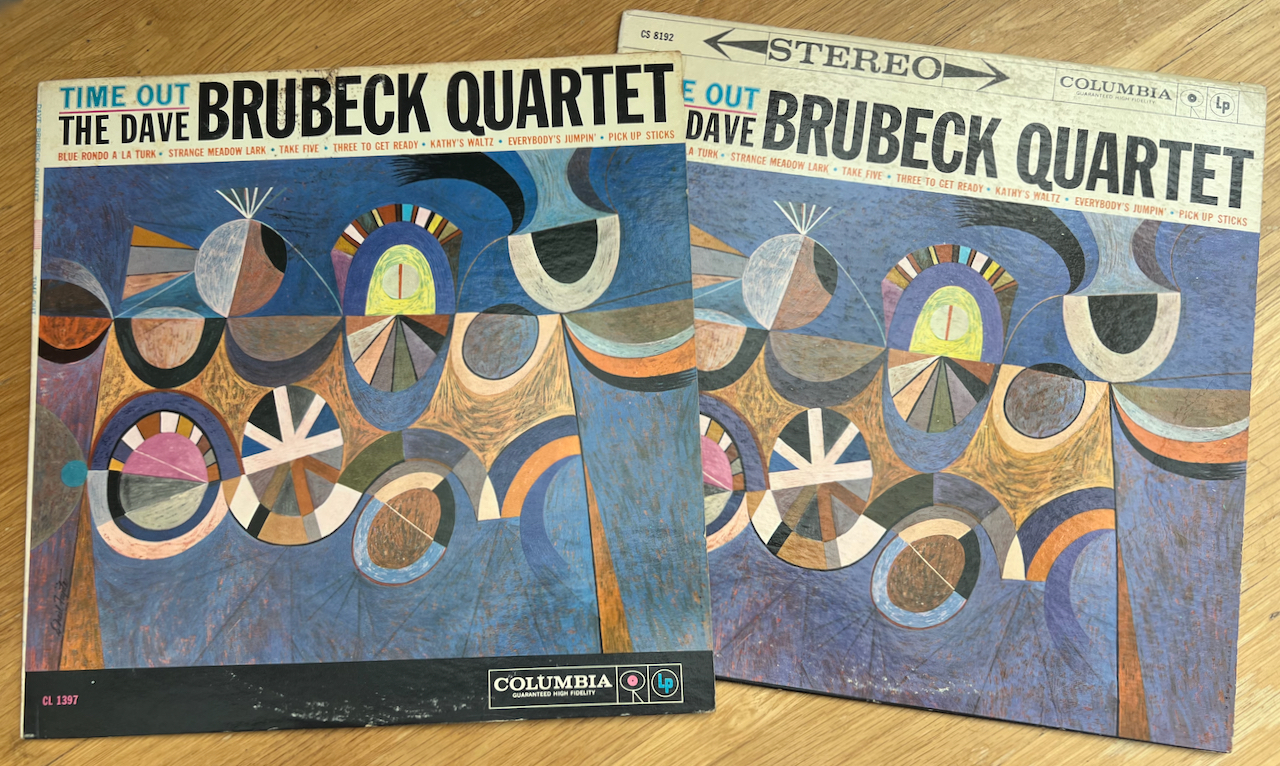
In short, we both strongly preferred the original (6-eye) US Columbia pressing, in both stereo and mono versions. The choice between the stereo and the mono was a much tougher one as it turned out. Generally, I tended to find mono to be musically more engaging and to sound just a little more ‘real’ than stereo, when played with a dedicated mono cartridge. But in the case of Time Out, both Tony & I put the 1959 stereo and mono ‘6-eye’ originals in more-or-less equal first place, with the mid sixties ‘2-eye’ re-pressings not too far behind. The UK original Fontana and slightly later CBS releases were quite close behind the US ‘2-eyes’. However, when we got to the various 70s pressings we found them to be notably inferior and often bettered by a modern ‘audiophile’ reissue.
I did write all of this up for publication somewhere but despite digging, I can’t find my original article – or even remember where it was published.
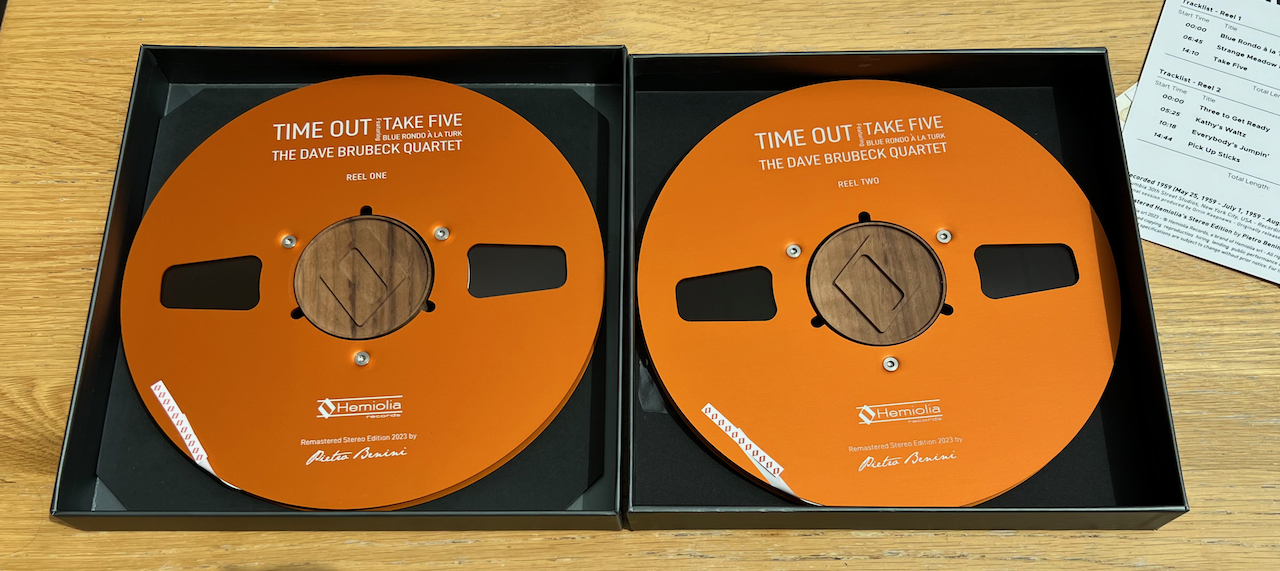
Anyway, fast-forward a couple of decades (during which time Tony very sadly passed away, far before his time around a decade ago) and I’ve since slimmed down my Time Out collection to retain just the original US Columbia 6-eye stereo and the 6-eye mono. So these are now my references against which I judged this new Hemiolia 15ips tape release.
More specifically, given that the tape is a stereo version, I began by comparing the tape against the original US Columbia 6-eye stereo (CS 8192).
Calibration time: setting up my levels

First things first: in order to attain an accurate and fair comparison, I needed to calibrate the levels of my tape, which in itself was quite an interesting experience. It turns out that the tape is actually a whopping 13dB louder than the vinyl! Okay, so tape sensitivity and phono cartridge level gain are all factors here, but I found that I had to set up my phono cartridge (a Clearaudio daVinci) and phonostage (an Aesthetix Io Eclipse) very carefully to ensure the appropriate gain and loading for the cartridge. Meanwhile my reel-to-reel player (a Studer A80) was correctly calibrated to CCIR 320nWb/m using the appropriate MRL test tape.
First impressions
My initial response on first listen was quite interesting, and it tallied with my initial feelings about Hemiolia’s master tape copy of Kind of Blue compared with the Analogue Productions UHQR vinyl that I reviewed previously. Here’s the thing… on very first impressions, the light, air, space and life of the LP seemed to be superior to that of the tape. Which, as you can imagine, took me rather by surprise!! However, this initial impression was not to stand up to time and scrutiny…
Anyway, I started off by playing the original 6-eye stereo LP. And oh boy, does this version sound good! It’s so alive, visceral, energetic and above all fun and compelling. Switching to the tape – and turning down the volume a lot (as mentioned earlier) – I was a little underwhelmed. In fact, it was only by carefully level matching and going back-and-forth several times, and playing at moderately realistic volume levels, did the truth of what’s actually happening here begin to reveal itself. Intrigued? So was I!


A second run at it
So, this time I’m listening at ‘more than background’ levels (though obviously still plenty quieter than the reality of having this four-piece combo in my listening room would sound). Now the tape really came alive.
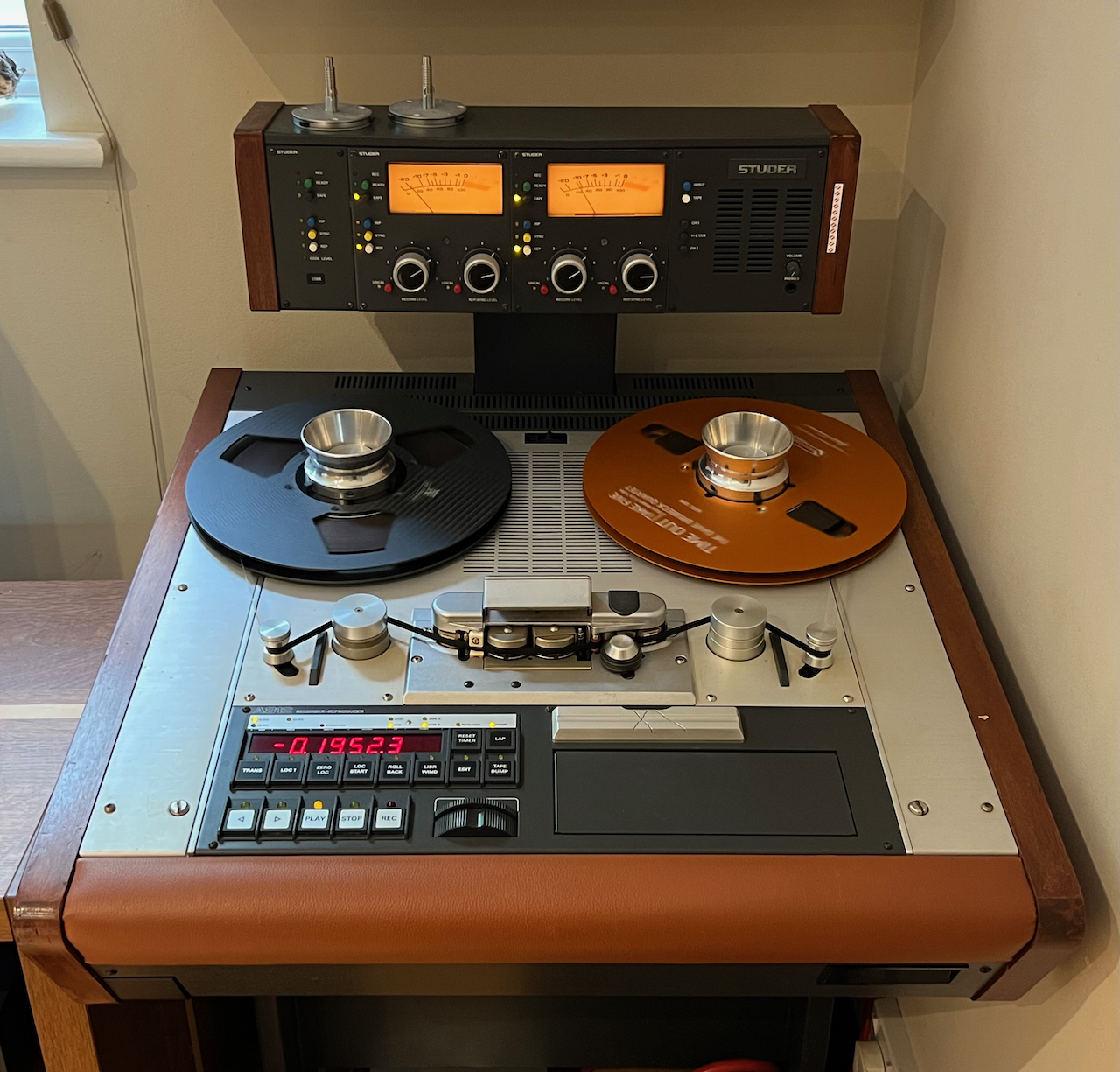 For example, let’s hone in on the soundstage and presence of each of the instruments, starting with the opening track ‘Blue Rondo à la Turk’. The drums are hard left (left of the left loudspeaker) and the bass is perhaps a touch behind but inside (to the right of) the drums, just off-centre in fact. The saxophone is pretty much dead centre and Brubeck’s piano hard right. In terms of front to back I’d say Paul Desmond with his alto sax stands at the fore, Jo Morello on drums slightly behind, Dave Brubeck on piano a tad further back than Morello, with Eugene Wright’s bass bringing up the rear.
The presence of the sax is utterly sublime, but only on tape did you get the real feeling of the playing, of Desmond’s technique, of an at-times vibrato-like effect, and let’s make no mistake: the timbre of the alto sax is creamy and lyrical, quite ‘clarinetty’ if you like, and very, very clearly not a tenor sax. On the vinyl LP, meanwhile, I note that the sax wanders into a slightly overdriven, over-saturated quality which, while not unpleasant, does detract slightly and therefore loses my total involvement.
 And then there’s the drums… again, my initial impressions (on viny) were of a fabulously splashy, shimmering, brightness and dynamic snap, but then further listening (turned up loud) revealed that on vinyl the drums were again (as with the sax) a little ‘toppy’ and lacking in weight. In fact this effect was even more magnified on drums than on sax; the drums felt fine for the upper half of the frequency spectrum, but rather lacking – or, to be more precise, somewhat ‘artificially hollowed out’ – in the lower registers. This album focuses the ear so much on percussion (it’s all about timing after all) and on the Hemiolia tape, the drums are extremely naturally weighted, with each and every hit being an absolute joy, whether it’s the snare with its very apparent springs rattling, the toms with their huge body and weight, or the cymbals, the kick drum – everything on the tape was, well, much more perfect than I’d ever heard it before.
Moving on to the bass, on vinyl this was quite soft, whereas on tape every single note was perfectly pitched and of equal weight. It felt so even. The music flowed and captivated and the elements that makes this album such a classic are simply just there, right in front of you. Songs are propelled along at breakneck speed with no fuzziness, and none of that vague ‘what’s the tune doing here’ unevenness.
And finally, the piano: on tape it’s undoubtedly less bright, which perhaps takes away from its spotlight somewhat, but the ‘payback’ is that it possesses a much more realistic weight and a full tonal palette. It almost seems to take a step backwards in the presentation: rather than behaving as a lead instrument it becomes the rhythm keystone, playing a crucial role in holding the bass, drums and the lyrical, dancing, alto sax together. I’d say that it was perhaps the piano which me took the longest to reacclimatise to. But as I’ve already said, once I’d got the new version, the Hemiolia master-copy tape, under my skin, it was a game-changer. Or, to put it another way…
Tape to vinyl? There’s no going back!
Actually, it’s probably worth focusing for a moment on what attempting to go back felt like, because for me that’s the acid test. Having listened to the Hemiolia tape a few times, going back to the vinyl – and we’re talking here about a vinyl version that’s been intimately-known and very much-loved for years – really failed to impress! In comparison, it felt hollow and without body. Most important (to me), it just didn’t involve me as much, I was no longer as captivated, I lost interest. Which, to be honest, felt a tad jarring at first (was I losing my mind? Imagining it?).
But then I returned to the Hemiolia tape and – boom, there it was again: that reality, that full body and shape, the texture and timbre of each and every instrument. There was no mistaking it, I was hearing every pluck of the bass string, and when the strings buzzed a little, I heard that buzz. Listening again now, I can hear how Brubeck attacks the piano: when one hand is beating out time and the other playing a melody, it makes perfect sense; when he lifts and presses his foot on the sustain, and when his fingers release each key, I’m so much more held in the micro-detail of his playing, the intonation of each and every aspect. I feel so much more in touch with the performers but the best is yet to come: Morello’s drums. From the staggeringly shimmering cymbals, to the fast attack whack of the drums, I hear each and every single drum and can practically locate the entire kit in space -each of the toms, the snare, the kick drum, they all have their own sonic attributes and every drum (and cymbal) hit sounds as uniquely individual as it really is, whether softly brushed or attacked hard. The overall effect is staggering, jaw-droppingly arresting, and all this time you have Chambers, Brubeck and Wright in full support.
I find myself unable to understand for the life of me how it took me a couple of listens back and forth between vinyl and tape to get here. I guess perhaps it’s a question of initial versus deeper presentation. I’d say perhaps I initially felt a tad uninspired due to the relative lack of brightness on the tape compared to the vinyl, but then was very soon replaced by the realisation that, with the tape, you have far more expression, far more feeling, far more intonation, and crucially, far more involvement.
In conclusion
 This tape has caused / enabled me to hear an album that I’ve known intimately for decades more deeply than ever before. It’s an album that I’ve compared endlessly in a variety of versions in pursuit of the absolute best version available.
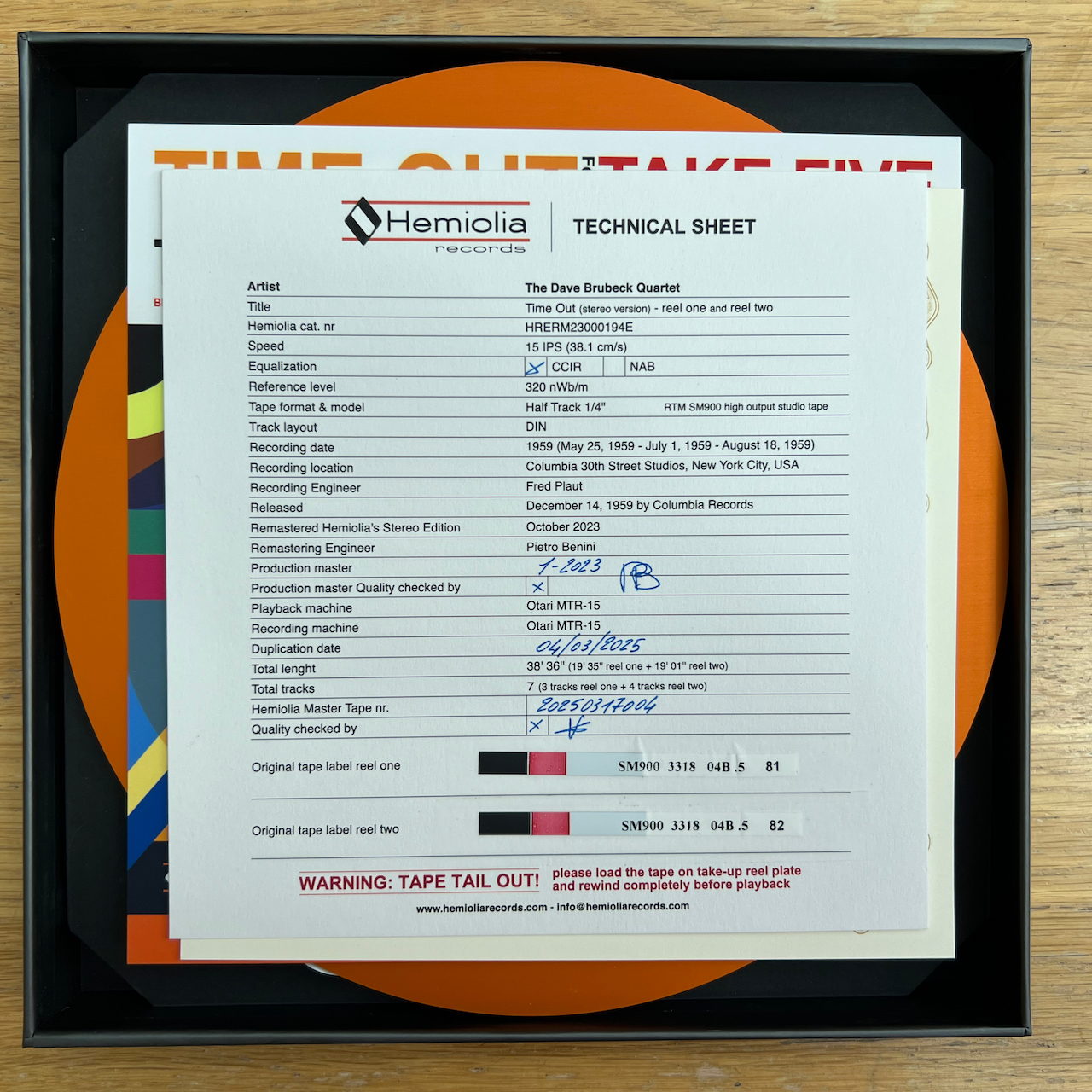
Well, currently, this is it. I very much doubt it will be bettered – unless Sony Universal decide to make their own master copies direct from the original master! So this Hemiolia ‘Pietro Benini remaster’ is now the one to beat.
Here’s the link: https://www.hemioliarecords.com/en/master-tapes/55-324-time-out-the-dave-brubeck-quartet-2reels-8050616581303.html#/1-equalizzazione-ccir
 Dave Denyer: The Reel-to-Reel Rambler