 Amid the limited but ever-expanding catalogue of music available on reel-to-reel ‘copy master tape’, the recent announcement by Analogue Productions of releasing five albums by an artist such as Bob Marley was extremely big news! For me personally, this is something of a holy grail moment. I’ve been massively into Bob Marley since way back in my university days. (Back then I was mostly listening to friends’ records, since I was a totally impoverished art student!). When the superb compilation album Legend was released in 1984, this became a top-ten album for me. Thankfully by that time I was working and could buy my own copy, which from then onwards was rarely far from my turntable.
The full vinyl experience
Over the years I’ve pretty much filled in a complete collection of the Island albums in the Marley catalogue, including finding some extremely rare gems: an original Catch a Fire in the Zippo cover and an Island Records white label test pressing of the original release of Exodus.

Still on the subject of vinyl, when Analogue Productions announced the release of Rastaman Vibration on UHQR in November 2022, I was fortunate enough to get a copy. Fortunate because the entire production run of 3,500 copies sold out within minutes and crashed the Acoustic Sounds (Analogue Productions’ retail arm) website!
That record was an eye-opener and a true revelation. Out of all of the Marley catalogue, I was probably most into Exodus, Catch a Fire, Natty Dread, Kaya, Uprising… I certainly liked Rastaman Vibration but not as much as several of the other albums. And then the UHQR arrived and was put on the turntable. Oh wow…!
The sound was noticeably different to my 1980 Island re-pressing. It was smoother but also more detailed, more dynamic and much, much more expressive. Tracks that had previously passed me by now caught my full attention. In fact, the track ‘Jonny Was’ completely stopped me in my tracks. It was stunningly beautiful, sensitive and passionate. I couldn’t stop playing this new version of the album, and literally every track became a real favourite. So that pressing of Rastaman Vibration has, for the past year-and-a-half since its release, become my most-played Marley – and this is even factoring in the UHQR release of Exodus, which had previously been my favourite Marley!
From vinyl heaven to tape nirvana…
When Acoustic Sounds subsequently announced the release of five – yes FIVE – Bob Marley UHQRs, including 45rpm double albums (not just the 33rpms of that original 2022 release), I was all-in. But it didn’t stop there: as well as the five 45rpm UHQRs (and 3 of those albums not already released as 33rpm UHQRs), all five titles were to be released as Analogue Productions Ultra Tapes. Woah… and jeez, these guys are going to bankrupt me – but I’ll go down smiling!!

Fast forward a few months and the first two of these five albums are rolling off the production line and it’s time to get listening. In order to fully assess their relative merits, I ordered both the 45rpm UHQRs and the Ultra Tapes of the first two titles: Rastaman Vibration and Exodus.
Since it was Rastaman that most notably wowed me with the 33rpm UHQR, I dived straight into that title and began by comparing my original reference (actually a 1980 re-press of the original Island release) with the 2022 33rpm UHQR – the one that had given me a ‘road to Damascus’ experience – the new 2025 45rpm UHQR vinyl, and finally, the Ultra Tape.
The 4-way listening test
-
The 1980 original
 Starting with my 1980 copy of the original album, one thing is immediately obvious: this is an exceptionally good sounding record. There’s nothing whatsoever wrong with this original. It’s dynamic, open, layered and really quite beautiful – and I honestly think it’s only because none of its tracks featured on Legend that I slightly overlooked it before getting the UHQR. My bad.
-
The 2022 33rpm UHQR
However, when I fire up that aforementioned 2022 33rpm UHQR, things really ramp up a notch. The sound is so open, so clear, so detailed and yet it’s also smoother than silk. Perhaps the one trait above all is significantly more expression in Bob’s vocals. I’d never heard him sound as sensitive and evocative before. I’ve already mentioned ‘Jonny Was’ and, to this day, this track, on this album, is probably my favourite Bob Marley track. It almost melts my heart.
It’s not just that particular vocal though. The whole album’s vocals are much more open and more detailed, without any hint of being clinical, or too bright or in your face. At the same time, the bass is deeper and tighter – more tuneful, and the keyboards and organ are more layered. This 33rpm UHQR wins hands-down, in literally every respect. It’s a huge testament to Ryan K. Smith, the mastering / cutting engineer who cut this at Sterling Sound which, very interestingly, is where the original was also mastered…
-
The 2025 45rpm UHQR
 So, let’s move on to the 2025 45rpm UHQR. How will it compare? Surely with all else being equal, it ought to move the bar up a notch yet again…
And indeed it does. I wouldn’t say it moves it by quite as much as the 33rpm UHQR did over the original, but there’s still a clearly noticeable step forward into uncharted territory (‘uncharted’ for me as I hadn’t yet heard the tape at this point). Everything was turned up a notch. The bass was deeper and more defined, and had slightly more power. The soundstage was more also defined and details were more apparent within it. Those beautiful keyboards were separated out a touch more and felt creamy, smooth and beautifully layered. And the backing vocals: the I-Threes, were much sweeter compared with the original, separate yet very natural sounding. Even Bob’s voice was more defined, you could begin to feel the space around him, his aura, if you like…
So, the bar has moved again. Not by a massive amount, but clearly the new 2025 45rpm UHQR is certainly the new reference to beat.

-
The tape
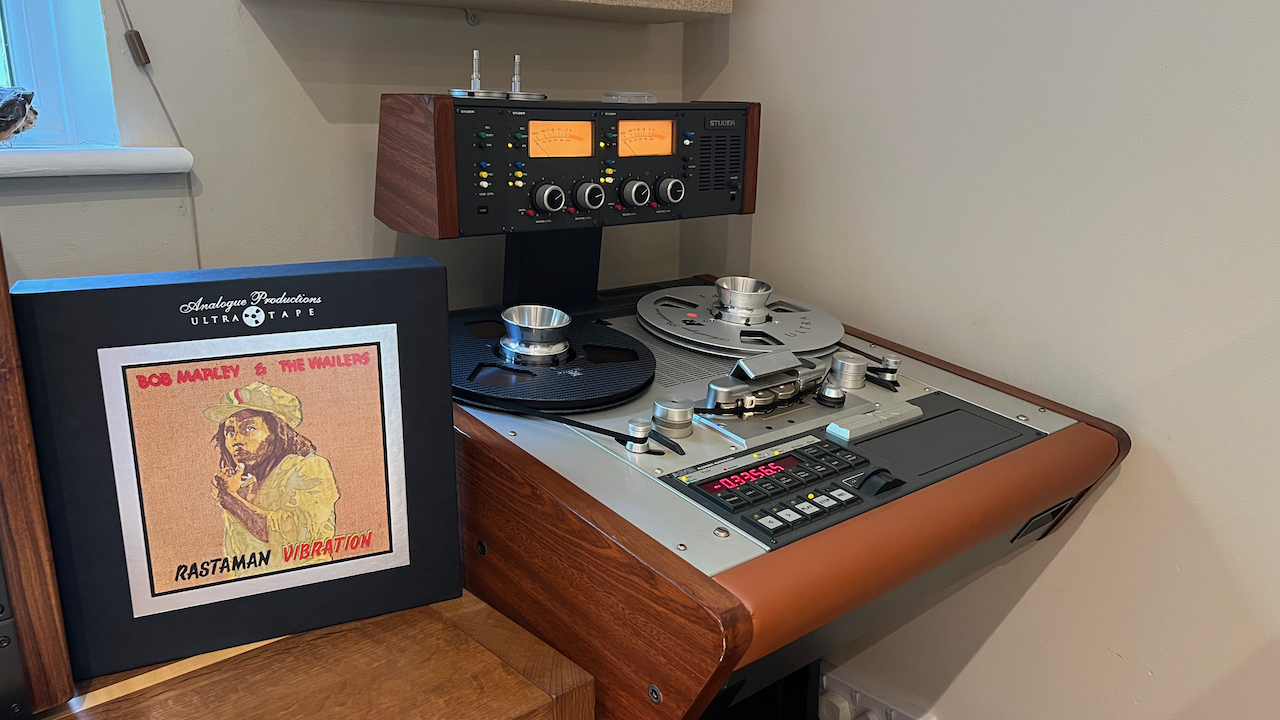
Finally, we get to the tape. Now this is interesting… where the two UHQRs had notably increased the openness and clarity, here I notice a slightly different feel: there’s more darkness in the air, it isn’t quite as bright when compared with the vinyl – not that the vinyl felt bright in any way, though. It’s only as I listen for a few minutes that the sound really unfolds itself for me…
The bass is deeper yet again, which isn’t surprising for tape, but the place where this really stands out is on the kick-drum (bass drum). Listening to ‘Want More’ I’m almost slammed in the stomach by the weight and power behind the bass drum. The bass guitar is deep and more powerful too, but those bass drum beats bring an almost subliminal level of involvement into the music. On vinyl, the bass guitar and drums seemed somewhat lightweight in comparison, but that’s only really apparent when going back: playing the UHQRs after playing the tape.
On tape, the keyboards are sublime. I’d never realised just how many layers there are in this recording. The keys are creamy smooth, yet full of analogue texture and timbre.
Vocally, the I-Threes stand on the left-hand side of the stage and they really sing. On the tape I hear them as life-size entities, with sweet, soaring vocals that perfectly compliment Bob’s voice and the other backing vocals.
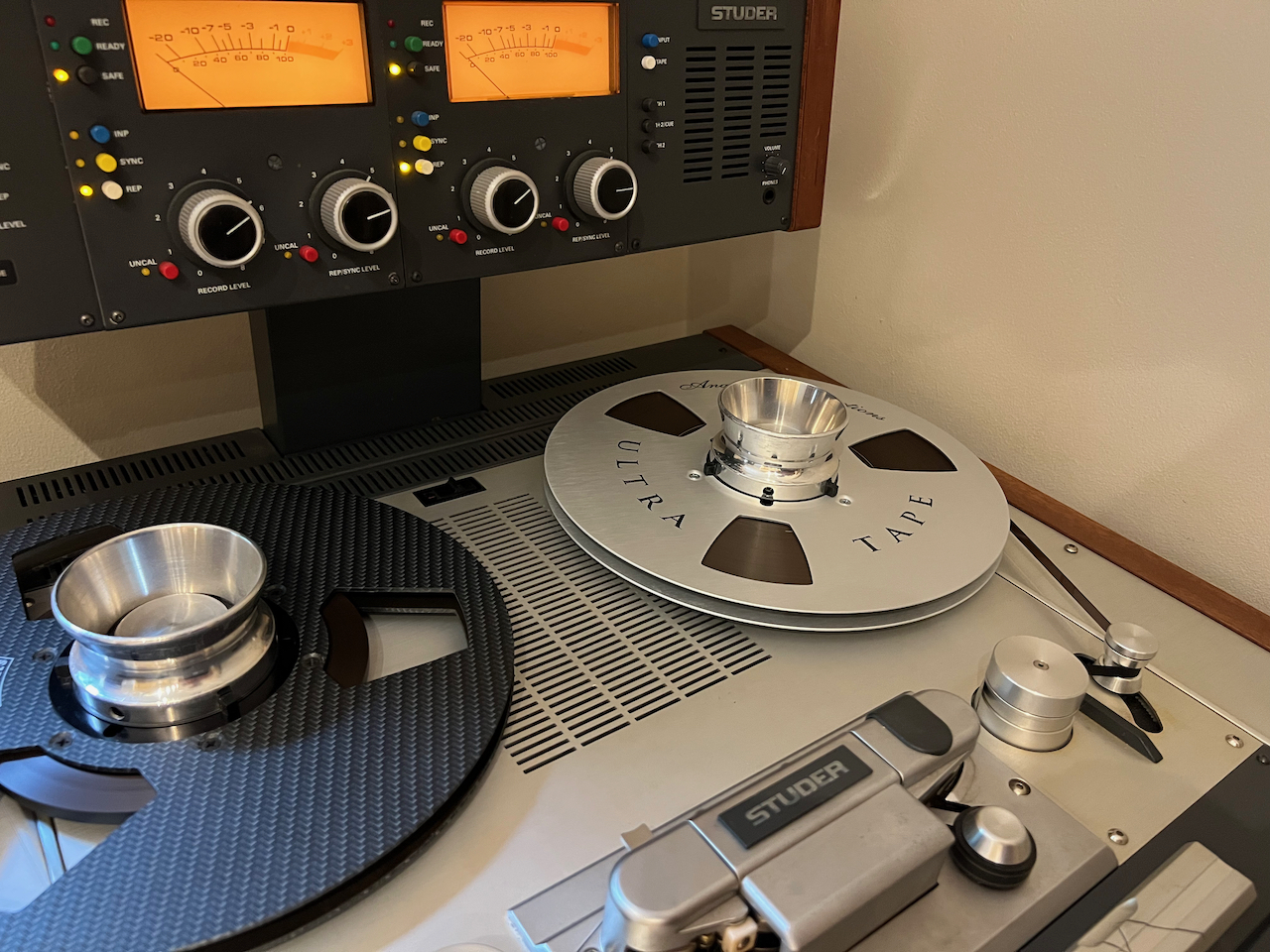 And then there’s the percussion: it has startling dynamic presence. Drums, shakers, cymbals and triangle leap out of the ether with such precision and authentic timbre that you’d almost expect it to grate but no, it’s so real it just ‘is’.
A similar effect is heard with the guitars, especially the lead which appears now and then front left of the soundstage. The more familiar reggae rhythm guitar ching, ching resides on the right-hand side. And the lead electric sounds like it’s right in your room, perhaps a foot or so in front of the left speaker. Yet it’s solid, real, physical, but not harsh, not fatiguing in any way.
Finally, I hone in on Bob’s voice. Remember, this was what converted me to this album back in November 2022. Here, we hear Bob’s voice properly, for the first time. Whereas the admittedly superb UHQRs give you the expression and sensitivity, they perhaps sound a little wraith-like in comparison with the tape: the image of Bob in your room is almost transparent, like a ghost, it doesn’t really have the same solidity or weight to it. On the Ultra Tape, you can almost see Bob, his head is solid, you can feel the weight and humanity of his vocal.
When the band signs “Jah Love, Jah Love, Jah Love” you will find yourself singing too, covered in goosebumps and perhaps with a tear in your eye. Bob Marley was, according to Peter Tosh, channelling God – and through this tape you might well experience your very own direct connection to the divine.
100% recommended, this is probably my favourite of all the ‘master copy’ tapes that I have so far. If you’ve read my raft of glowing reviews of all manner of tapes, then you’ll know that this is really saying something!!
If you have an appetite for more on this one, check out my video review on YouTube:
You can find out more and order the Rastaman Vibration Ultra Tape at:

 Dave Denyer: The Reel-to-Reel Rambler