Well, folks, this is the moment! Having championed the resurgence of reel-to-reel tape, with a particular leaning towards ¼” 15ips R2R master copies, for around a decade now, it seems that my Holy Grail has finally materialised…
Not that I’ve been starved of incredible choices, mind. The past ten years have seen some very significant happenings in the world of tape. Analogue Productions launched their awesome Ultra Tape series, Hemiolia did their deal with Ermitage to add some absolute ‘must have’ titles to the reel-to-reel tape catalogue, and then there was the purchase of Horch House by Revox and the introduction of the new Revox B-77 Mk3 R2R tape recorder.
Ten years ago, all this this would’ve seemed like fairy dust, right? ‘Impossible’ dreams! And now perhaps the biggest news of them all, IMHO, is a major record company releasing their own catalogue of reel-to-reel flat master copies. That company is Rhino Entertainment, essentially the back-catalogue division of the Warner Music Group.
The list of labels that fall under the Warner Music Group umbrella makes for a staggering read. For us reel-to-reel fans this is astoundingly exciting news. So, as soon as the announcement came last month, I dived straight in and ordered both of the first new titles! To be honest, I would’ve almost certainly done that regardless of what those titles were, out of curiosity and in order to review them here on my Reel To Reel Rambler webzine. But who knew that one of those two releases would be an album that’s in the top five albums from possibly my all-time favourite band… SHUT. THE. FRONT. DOOR.
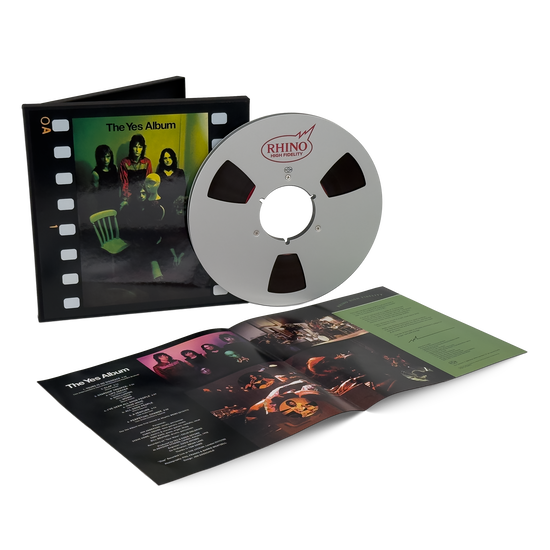
Of course, that album is The Yes Album. So, after what seemed like an age (but was actually only around two weeks) the postman finally delivered my tapes, after I’d paid the not insubstantial customs and VAT charges (around £120 for two albums).
The unboxing (which surely warrants a drum roll…)
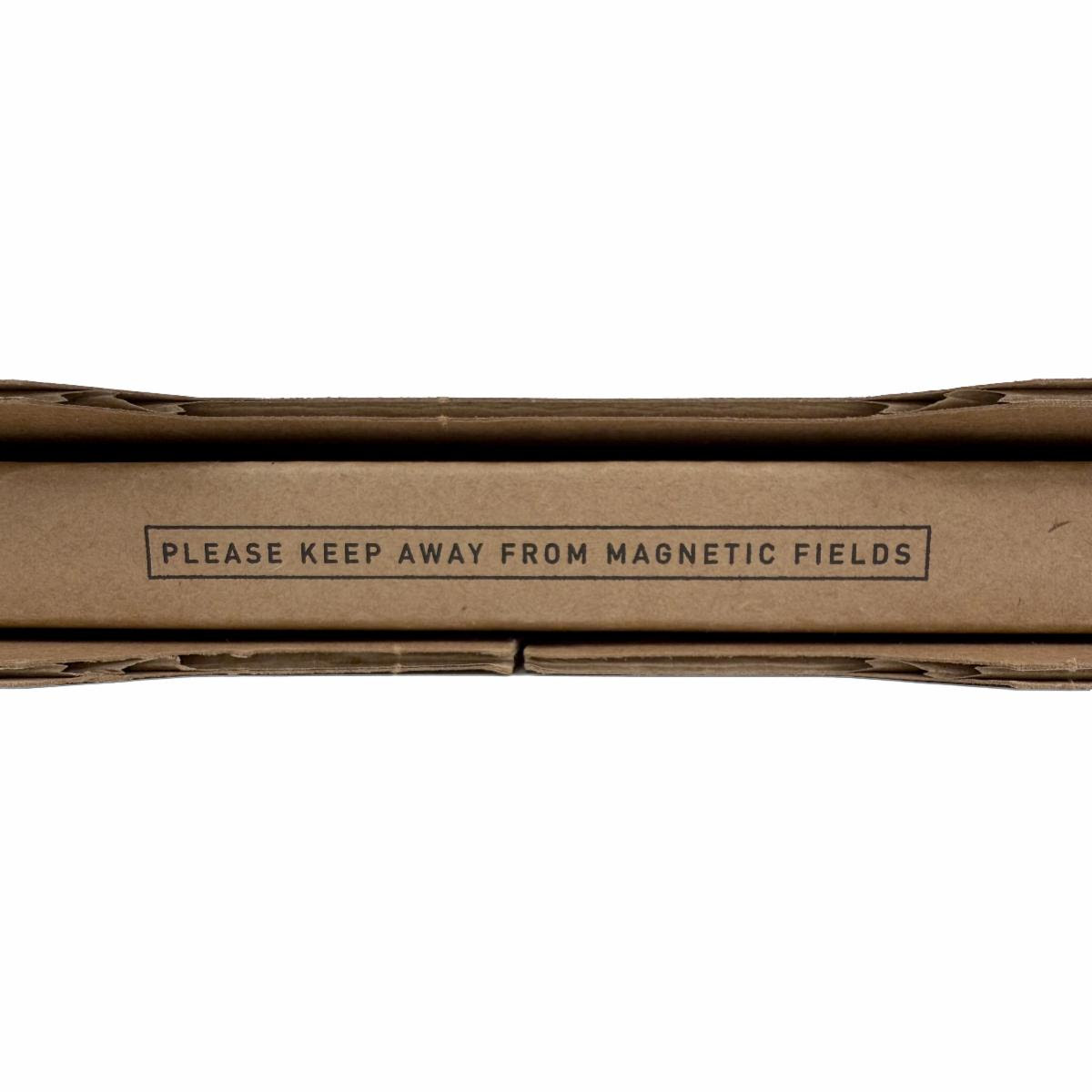 The outer packaging is rather a smart corrugated cardboard affair with really nice Rhino tape printing. It’s also highly practical, no doubt designed to absorb all but the most severe of transit bumps. Inside, my two tape boxes arrived in perfect condition.
And those tape boxes deserve a bit more description. They’re essentially the standard Recording The Masters 10.5” metal reel boxes, but in this instance they come in a very smart black, including all the inserts. On top of these are pasted some very high quality artwork in three pieces: the spine, front and back covers. The front and back covers in particular look stunning with spot-varnishing applied to give a high gloss and semi matt effect. They’re really rather beautiful and I can just imagine a shelf full of these tapes… and if they happened to be more Yes titles… that thought is mind-bogglingly good!
The tape’s hold-down tape is printed with the title (The Yes Album) and the number of your copy. Mine is number 56, out of a strictly limited run of 500.


I mean, seriously, this is just nuts. I’ve got it here in my hands and yet, still, I’m pinching myself and shaking my head in disbelief.
By the way, if you visit the Rhino store right now, The Yes Album is listed as ‘pre-order’ so I’m guessing maybe only half of the 500 have already been made and these have already sold out – which is truly encouraging because if this is a success then I’m sure Rhino will continue with this project.
The production: Recording The Masters
What’s interesting is that these tapes are listed as being made at Recording The Masters in France. I contacted RTM and was told that this whole project was being handled by RTM’s Tim Chapman, so I got in touch with Tim to find out more.
It transpires that the tapes are produced from an exact 1:1 copy of the original master tape, which was made by Rhino themselves. This original master tape (or perhaps tapes, as rumour has it that Rhino made four copies to send to RTM) is then played back on a Studer A810 and via a specially made distribution amplifier, fed through to a bank of five highly tuned Revox PR99 recorders. This means that for the 500 total run, the source tape (the flat copy master) is played back 100 times, or if rumours are correct, then the 4 source tapes are each played back 25 times. Either way, what you’re getting is a master copy two generations down from the first original. This is in fact normal practice and matches what you’d get from, say, Analogue Productions or The Tape Project. Fantastic!
 Another point of interest is the tape used: it’s Recording The Masters own superb LPR90 tape. LPR90 is perhaps my favourite tape, not the absolute ultimate in quality, but all things considered it’s the tape I use the most. It is essentially the long play version of RTM’s SM900 which is the best tape that RTM make. The LPR90 uses the same oxide formulation, just with a thinner backing coating (1 mil vs. 1.5 mil) which allows for 48 minutes per 10.5” reel rather than the SM900’s 33 minutes.
The advantage of this is significant. It means that most analogue-era albums will fit onto one tape, halving the raw material cost of producing these master copies and hence allowing the albums to be made available at a much lower cost ($300 rather than the typical $500 and up). Also, they take up less shelf space, and of course there’s no need to change reels in order to play ‘side two’ of an album. When the very best sounding versions of most albums (such as The Yes Album) are currently the awesome Analogue Productions 45rpm vinyl versions, this is a massive boon.
On which note, let’s digress for a moment and talk about another fabulous Yes album: Close To The Edge. The current best-sounding version of that album (IMO the A.P. 45rpm) requires turning over LP one halfway through the first track because the ’LP sides’ need be split in two (a standard album being on two LPs). The same will apply to the forthcoming Analogue Productions 45rpm release of Genesis’ Foxtrot, and in the case of Genesis’ The Lamb Lies Down On Broadway, originally a double LP, the 45rpm version might well sound amazing, but over eight sides, changing sides / discs does begin to get a tad much…
So, all things considered, what we have here is one of the very best advancements in the whole reel to reel market. (The other being that we have Revox back making machines again, plus their incredible tape catalogue which, thanks to Volker Lange’s immense efforts over the past ten years, continues to grow at a rate of knots. Currently Revox / Horch House have approaching 200 titles.)
Listening to The Yes Album
OK, so let’s gets down to business. Now I’ve unboxed my precious new tape, placed it (tails out) on my tape recorder / player and pressed rewind. There’s one point I’ll note here: there’s a very long red leader tape, which is really applaudable. I’m not a huge fan of lacing up tapes, and so having a massive amount of leader means that it’s a cinch to stop rewinding while the leader is still wrapped around the tape reel. A massive thumbs up to Rhino / Recording The Masters for this!

Then we press play…
Oh hang on, one more thing – I ought to point out that these tapes are duplicated at 320nWb/m, which is perfect really. 320nWb/m is a very commonly used studio standard and is also the level used by most ‘master copy’ tape labels, so it makes setting up your tape machine dead easy – simply set it up for 320nWb/m CCIR replay (or get your tech to do it) and then forget about it.
 On my Studer A80, when those first notes of ‘Yours Is No Disgrace’ power though my speakers, the VUs leap wildly into the red… these tapes are recorded hot! I’m guessing they’re at least 320nWb/m +6dB, but it could well be more. This makes best use of the tape, LPR90 being a very high output tape, and in so doing it minimises tape hiss. Another win-win situation.
Anyway, it doesn’t take me long at all to let go of thinking / assessing / analysing mode and allow myself to be utterly and completely drawn into the music, which that is of course what it’s really all about.
My first impression is that everything is so clear and clean, there’s no distortion, no swamping or squashing of dynamics as the music gets loud. The sound is massive without audible compression, and of course vinyl-related things like tracking errors are completely absent. There’s a choir-like quality to the voices: Jon’s lead vocal sounds divine and also Chris Squire’s and Steve Howe’s backing vocals are beautifully portrayed. It’s honestly like you’re hearing them for the first time. The voices are soft, yet textured and solid. Intuitively, you know this is right even though you may have listened to this album many hundreds of times before on LP, CD, or cassette. There’s an inherent ‘rightness’ about it – that feeling when things just ‘click’. It sounds so real and so natural, you 100% know it’s right.
And that feeling, that experience, extends way beyond just the voices. Tony Kaye’s organ has a texture, a dynamic weight and a solidity to it that you’ll have never heard before. The growl of the organ-bass notes in the opening track is truly earth-shaking, yet it doesn’t muddy-up anything above it. The rest of the ensemble plays with absolutely no intermodulation, no over-saturating, no blurring; even the quietest, tiniest cymbal ‘ting’ or shaker rattle is heard through the maelstrom of activity. It’s like holographic. Amazing!
Bill Bruford’s drumming is another eye-opener. The sense of timing, partly due to 15ips tape’s inherent speed stability and partly due to tape’s awesome bass weight and detail, leads to a revelatory change in perception of timing and weight. Bill’s drumming is utterly spellbinding. I often hear people far more qualified than me rave about Bruford’s drumming, and while I’ve always agreed, albeit without the experience of actually being a drummer, on this tape it becomes blatantly obvious. The way he plays, entwining around the melodies – it’s spell-binding. I found myself listening to the whole album, rewinding and then listening again, eager to hear what Bill was really doing again, and again.
And no description of any Yes album would be complete without reference to perhaps the instrumental kingpin around which the band revolves: Chris Squire’s bass guitar. As often discussed here on The Rambler, one of the most immediately apparent qualities of tape is the bass performance. Bass carries full weight: most often the bass is EQ’d down for vinyl, just so the stylus can stay in the groove. No such squashing is required on tape. Chris Squire’s bass is allowed full rein to explode with power, texture and technique – and boy, does it ever. In combination with Bruford’s drumming, this is tear-inducing stuff!
So you might be thinking ‘he hasn’t mentioned Steve Howe’s guitar yet, is that for a reason?’ Nope, absolutely not, I’m coming to that right now. Steve’s guitar is just as positively affected by ‘the tape effect’ as every other strand of the music. Just as with the keyboards, bass and drums, the guitars never get messy or blurred despite the music getting incredibly loud at times. Take ‘The Clap’ for example. The precision and utter speed and dynamics of Steve’s picking, and the explosive quality of his strums, are jaw-dropping.
Everything holds together on this tape, you’ll have never have heard ‘Würm’ anything like this before, and when you get to the finale of ‘Perpetual Change’ and the band fades in playing over itself in a different time signature, lorks alordy, you’d better hold on to your hat. It really is like having two Yes’s both playing hell for leather right there in your listening room!
Final thoughts
So, to sum up this release, I think it’s just incredible. There may be some who might think, ‘well we could have had it on two reels of SM900 at twice the price’, but there’s always going to be a balance between reaching for the ultimate versus making something wonderful more accessible to more people, right?. As for me, I’m happy as Larry. What we have here is the first ever reel-to-reel release of one of my top ten albums, and with Rhino Entertainment having joined in the party, the possibilities for future releases are unimaginable. I’m watching this space with eyes pinned wide.
As a final point, I’d like to extend a request / consideration to the folks at Rhino ad RTM: might there be any chance of making 4-track compatible 7.5ips versions (on 7” reels) for those 4-track reel-to-reelers out there? And, while we’re on the subject, why not consider a limited quantity of ultra-high quality real-time duplicated cassettes, direct from those same ‘flat master copies’? Something this good really does deserve to reach far and wide.
Links to find out more and buy:
https://store.rhino.com/products/the-yes-album-rhino-high-fidelity-r2r
 Dave Denyer: The Reel-to-Reel Rambler