 A few days ago I posted an introduction to new tape label TWINN, from the UK analogue outfit Night Dreamer.
Being new, there are just four releases at the moment, but boy did the fourth one catch my attention. While the first three are relatively new recordings, the fourth goes back to 1971, to the era-defining studio debut from American visionary / poet / prophet / composer Gil Scott-Heron: Pieces of a Man.
Ever since I first heard the album – sometime around the turn of the century – I fell in love with it. Head over heels, and it’s remained one of my all-time favourites ever since, an absolute Desert Island Disc. I can listen to it over and over again without ever tiring of hearing it. Regardless of whether you happen to be religious or spiritual or secular, Gil Scott-Heron speaks to your soul, he gets into your guts, he sees your humanity.
He’s one of those few artists whose work I’ll buy on sight. I don’t have everything that Gil released but everything I do have is very special. And, standing head and shoulders above all, is Pieces of a Man. His records don’t turn up very often in second-hand record stores. I guess people hang on to them, which says it all. It’s also a testament to the timelessness of his work. Nothing is dated, nothing becomes irrelevant, in fact Pieces of a Man is probably more relevant today than it was back in ’71 – I mean, listen to ‘The Revolution Will Not Be Televised’ and tell me that’s not 100% here and now.
‘Lady Day and John Coltrane’ is another of my favourite tracks on the album, it just aches with the funk, jazz, blues. It’s a perfect melding of genres that creates something that can lift you high even when you’re feeling down. It’s that particular gift of Scott-Heron: to deal with extreme adversity and to turn it into hope, into inspiration packaged with a humongous dollop of hell-yeah groove.
‘Home is Where the Hatred Is’ is another phenomenal piece of work that can lift even the most haunted of souls. Seriously, I’m convinced that this album must have saved countless lives, rescued lost souls on the brink. It brings sunlight into the darkest comers, not shallowly brushing over problems, not ‘not seeing’ the darkness: it stares the devil right in face and demolishes him!
Anyway, let’s get down to business with this new tape…
The TWINN analogue archive master copy

When the 2022/23 50th Anniversary double 45rpm LP version of the album was being produced, and also while the 2023 Electrical Recording Company release was being made, TWINN’s Neal Birnie was in the studio. His background involves working on audio restoration: preparing master tapes, and even sometimes working from vinyl or acetate, to make the recordings ready for remastering. So Neal was ‘in the room’ when the original Flying Dutchman archive master tapes were being used (lucky guy).
The TWINN Pieces of a Man release is, therefore, an exact archival duplicate of the original master, the archived master tapes held by the original label Flying Dutchman i.e. the very same tapes used for the above-mentioned two releases.
Gil Scott-Heron – Pieces of a Man – TWINN’s copy master tape(s)
You’ll notice the ‘(s)’ in the title above, well there’s a reason for that: TWINN have elected to make Pieces of a Man available in two forms; as a single reel recorded onto Recording the Masters LPR90, and also as a two-reel exact duplication of the original two tapes onto Recording the Masters reference-level mastering tape SM900.
Now, finances and shelf space would normally dictate that I’d go for the single-reel version on LPR90. I personally believe that for purposes like this, there is precious little separating the sound quality of LPR90 and SM900. Sure, in the studio if you wish to really push the levels then SM900 can be pushed that bit further, by nature of it being a 50% thicker tape, both backing and oxide layer. But bear in mind that it’s in fact the same formulation, so if studio pyrotechnics aren’t on the agenda, then to all intents and purposes they’re the same tape.
 BUT… this is one of my all-time favourite albums and I wanted the absolute best, so it had to be the two-reel version! (This cost me £550, whereas the single reel version costs £350.)
Interestingly, the single-reel version can either be 15ips on LPR90 or unusually – and great news for those that don’t have 15ips machines – 7.5ips on SM900. Each tape is made to order and, within reason, to each individual customer’s requirements. Moreover, the tapes can be supplied in either CCIR or NAB equalisation, further ensuring that the widest range of customers can get exactly what they need. Happy days folks!
The unboxing
When it comes to presentation and packaging, TWINN deserves considerable credit. For the two-reel version, two entirely separate packages are supplied. The single-reel versions are identical, but in one package. (So, for our purposes here, describing either is effectively the same, you just literally get two of the same boxes with the two-reel version.)
 The outside casing takes the form of a very smart black hinged sleeve. On the front is an extremely nice, high-quality reproduction of the original album cover. The colours are rich and lush: more so in fact than even the original, and very much nicer than the 2022 45rpm edition I reviewed a couple of years ago. An encouraging start, and we haven’t even opened the boxes yet…
On the rear face is another label showing the ‘ALBUM MASTER INFORMATION’. This includes the original recording information (recording dates, studio locations, album release date, original catalogue numbers) and the track listing and timing information, plus the full writing and production credits. Also, there’s the rights and licensing information. In this case the license was granted by Ace Records, even though the source tapes were the original analogue master tapes which Birnie obtained direct from Flying Dutchman’s archive, as mentioned previously.

Also on this rear label are the TWINN catalogue number (TWN005) and something I really like: ‘CERTIFICATION’ the name of the owner (me, you), the date your copy was made and Neal Birnie’s signature denoting that he personally ‘signed off’ this copy. Lastly, there’s a large stamped ‘edition’ number: that is, the number of your copy (mine is 006).
Everything about this feels luxurious, right and proper, authorised and authenticated. It feels like an extremely precious artifact – and I still haven’t even opened the box yet!
Packaged alongside the outer box is a small booklet labelled ‘TWINN ANALOGUE ARCHIVES”. This lovely little booklet explains what TWINN releases are and explains proper care instructions: how to thread a tape machine, what ‘tails out’ means, information about equalisation, etc. It’s a really neat addition to the package. But perhaps most important, it contains visual and written instructions on how to get into the box… believe me, this is not immediately obvious!
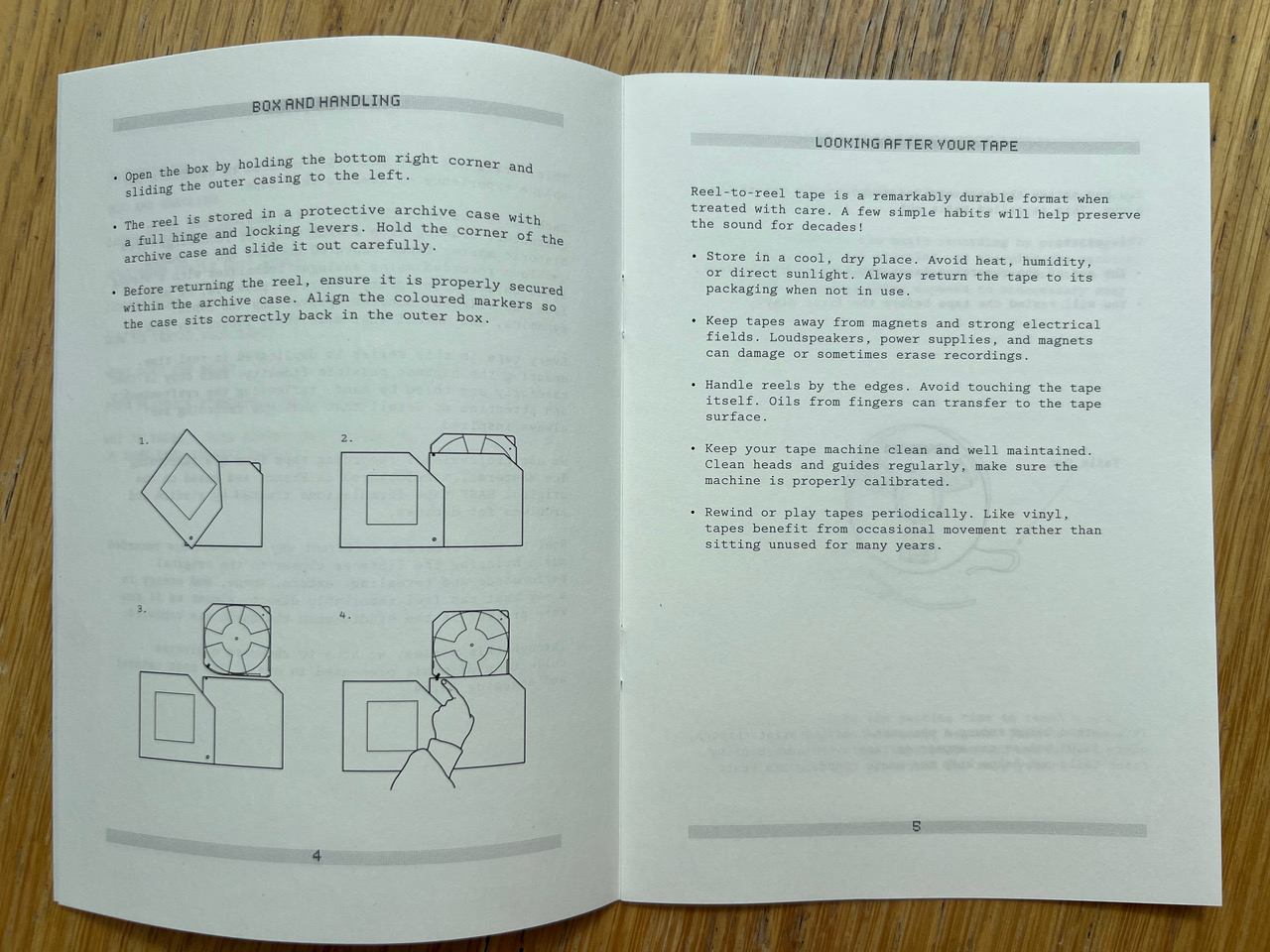
What you do is to hinge the top part of the box up away from the lower internal tray. Then you lift out the internal “STIL” tape-safe caddy box. These are the same boxes used by Revox / Horch House and are carefully designed to ensure that your tape is housed in the perfect conditions. You’ll note the there’s a small white dot on the STIL tape caddy and also on the inner part of the outer hinged box. This is so that you can actually put your tape away again after listening. The box does feel a bit like cracking a Rubik’s cube, but once you’ve learnt how to do it, it just adds to the ritualistic feeling of playing this wonderful tape.
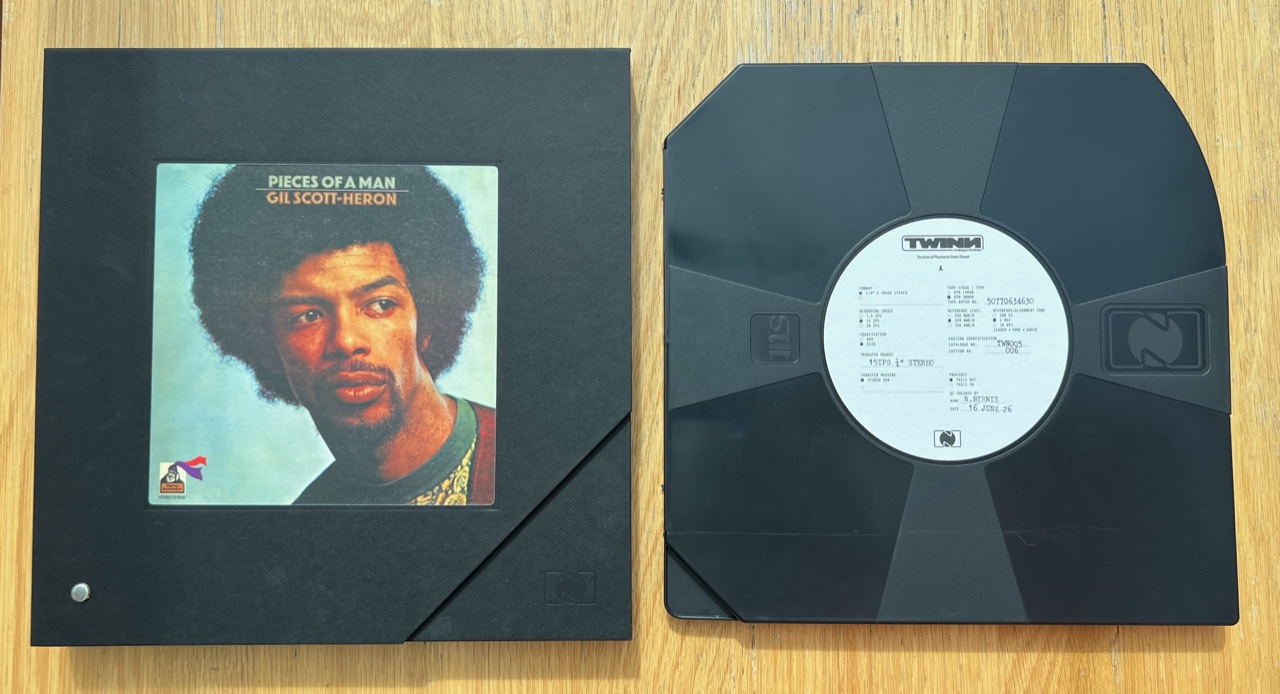

Anyway, once you’ve extracted the internal STIL box, you encounter yet another label: this one details the chosen specification of your copy: the format: ¼” 2-track stereo, the ips speed, the NAB or CCIR equalisation, the transfer source, the transfer machine, the tape stock, the reference level: 320nWb/m, and the reference tone(s). My copy features a 1kHz tone before the music starts, not only that, but it features the 1kHz tone at the start of BOTH REELS (more on this later)…
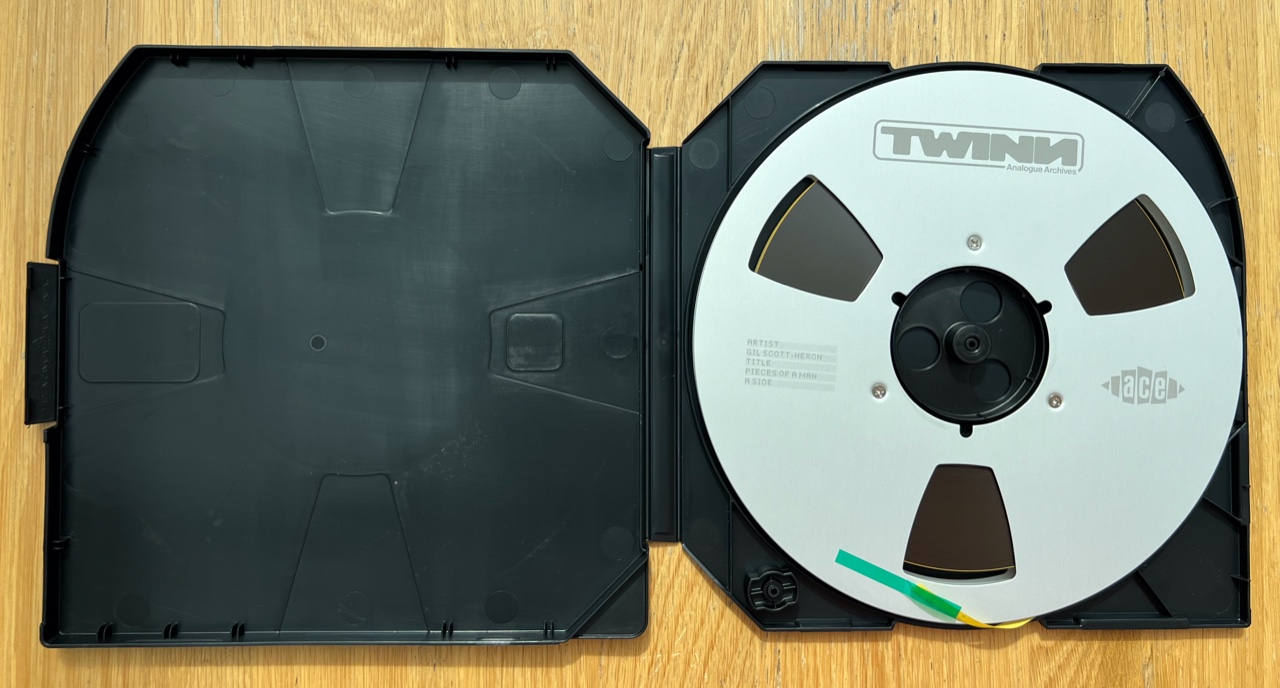
Now, after what feels like a thousand words of description (sorry), we open the STIL tape-safe caddy box. Finally we’re looking at the reel itself. The smart aluminium reel is tastefully laser etched with the TWINN logo, with the ACE Records logo, with the artist and album title and, in the case of the two-reel version, with the reel number (side A or side B).
This whole presentation is as good as any tape offered by any label in my opinion – maybe equalled in some respects but certainly not all, and definitely not bettered by anyone.
And there’s still more to come…
Tapes and tails
This tape, like all 2-track master copies, is presented ‘tails out’, meaning that the tail end of the album is on the outside of the reel and the start is closest to the centre. So the reel needs to be loaded onto the right hand reel table and rewound before play.
Well, the tail of TWINN releases is not blank tape, it is NOS yellow AGFA-GEVAERT leader tape. AGFA-GEVAERT was a forerunner of Recording the Masters – see my earlier report on a visit to RtM for the full history.
This was standard European studio practice back in the day. In accordance with this practice, the convention was that the ‘leader’ tape, i.e. the tape at the start of the reel, was red and white striped for 15ips stereo (approx. an inch of red then an inch of white, an inch or red, and so on). Blue and white indicated 7.5ips stereo. Mono 15ips was solid red, and mono 7.5ips was solid blue.
Anyway, back to Pieces of a Man: rewind the tape back to the start and you’ll see that NOS red and white leader – wonderful! The only other company I’ve seen do this is Horch House / Revox. This is absolutely first class attention to detail.

But wait, there’s still more: rewind past that first section of red and white leader and you’ll reach more recorded tape containing the tones. Wind back beyond that, and you’ll get to the very start: more red and white tape. So, playing from the very start of the reel, you get genuine new-old-stock red and white leader tape, then the set-up tones, then more leader tape to separate the tones from the music, and finally the album itself, finally finishing with more correctly colour coded ‘leader’ tape – the yellow ‘tail’.
Honestly, whilst some companies do some of this (e.g. Revox use the correct leader colour regime and the STIL tape safe boxes, Hemiolia use laser-etched reels etc), nobody else does it all. Hats off to TWINN for these exceptional archival master tape copies. These are clearly made with genuine love and care. Exquisite.
And now for the listening experience
Reel 1
 When the opening bars of ‘The Revolution Will Not Be Televised’ flow from my speakers I’m held in awe. I’m also surprised (in a ‘knocked for six’ kind of a way). I’m used to a small, intimate soundstage, one that feels very much like being tucked away in the corner of a larger studio. I’m used to hearing the drums on the far right of the stage, with Gil central and very little existing on the left. With the tape, that same studio set-up remains, but the sound is HUGE, dynamic and wide. The drums are still far right but now the kit is life-size – and some, and are key to the way the song’s story unfurls with a whole new urgency.
It’s an unusual soundstage but one makes you feel like you’re in the studio – the studio in this case being RCA Studios in New York City, where they’ve set up very much as if playing live in a club setting. That’s what you hear, in every tiniest detail. Honestly the feeling of being there, of absolute connection, is unparalleled.
All the way through the album, the great Bernard Purdie (on drums) drives song after song, relentlessly but with a sensational swing and not even the subtlest brush stroke or tap that’s superfluous or unnecessary. His style is of sparseness, of space, allowing the band to dovetail together like the cog-teeth in a fine watch. Nothing grates, nothing clashes, no-one treads on anyone’s toes. The music feels entirely free, flowing, and melodic. It holds your attention, and allows your mind and soul to open wide and allow everything in.
Interconnecting intimately with Purdie throughout the whole album is none other than Ron Carter on both electric bass guitar and acoustic upright double bass. His input mirrors Purdie’s, bringing a natural flow and swing that never obscures the message, but holds your psyche open and receptive. Both the bass and drums have a sublimely natural weight, texture and timbre. They stop and start on a dime. Not even for a split second does anything feel vague or unresolved. On some tracks, Purdie’s input is limited to just hi-hat taps, maybe expanding to include a couple of snare taps, and that’s it. He’s the master of understatement, of allowing space for the composition and the message to be got across. At all times the musicianship delivers ‘just enough’, nothing flashy or showy, not ever.
Alongside bass and drums, the other main instrument is the piano. Scott-Heron’s long-time collaborator Brian Jackson is at the helm, though his instrument varies according to the song. In some numbers it’s a Rhodes electric piano with its characteristically creamy tone and on other tracks it’s an acoustic piano, recorded with tremendous dynamic weight, colour and tone. On some tracks he’s to the right of centre and on other, the electric is on the left, and the piano forms a key part of the recipe. Adding yet another rhythmic element, keyboards are played to interlock with, not clash against, either the bass or drums. They add tremendous colour and contrast.
Floating above the bass and drums like an esoteric spectre, Hubert Laws’ flute glides on the air, bright and ethereal, sweet and smooth. It scythes through the space hauntingly with such ease, such creaminess. It’s bright but never glaring. On ‘When You Are Who You Are’, and the sparse almost cinematographic ‘The Prisoner’, Laws swaps his flute for the saxophone, adding more colours to the palette for this amazing album.
Finally, there’s the electric guitar, played by Burt Jones. The guitar appears in small amounts, like seasoning, apart from the occasional ‘solo’ such as on ‘When You Are Who You Are’.
Then there’s the man himself, Gil, always dead centre stage, in front of the bass, singing with such depth, warmth, intensity and (when required) desperation. Compared with my 1971 original promo vinyl, everything in the soundstage, vocals, drums, bass, flute has significantly more weight, depth and body, more dynamics and more scale. Going back to vinyl after playing the tape seems wishy washy, thin, bright, lacking in body and reality. For those who aren’t familiar, I did a YouTube video on my vinyl copies a couple of years ago which you’ll find at https://youtu.be/gWJX3eECiLg?si=l6lcgcMtLIy2fUsO). I consider my 1971 original promo to be a stunning LP record, but compared to this tape, it’s shrill, thick, edgey, confused, shallow and, quite frankly, not worth listening to (shit, sorry folks – tape just keeps on doing this).
In short, this tape is jaw-dropping – compared to even the best vinyl, listening to this album on tape is like a road to Damascus revelation.
But I’m getting ahead of myself. Going back to my track-by-track listening, ‘Save The Children’ comes up next and introduces Brian Jackson’s trademark electric piano, which is deliciously creamy and sits to the left of the soundstage. The sense of timing from Purdie’s drum kit is sublime here, and just to Purdie’s left is Burt Jones on an extremely rich, colourful electric guitar, next to which is Laws’ flute. Meanwhile, just to the left of centre, Carter’s bass plummets into the depths with body, texture and intuitive integration with Purdie. Capping off the whole is (of course) Gil Scott-Heron with his soulful, achingly beautiful poetry. His voice is so much richer than on vinyl, so much more detailed – it’s positively dripping with colour, life and emotion.
Like I said earlier, I’ve generally had ‘Lady Day and John Coltrane’ – the next track – down as my favourite one. But it’s a tough one to call on this album, because the bar is set so crazy high throughout. The piano, bass guitar and drums sail through this track with an unstoppable energy. It’s not rushed, it swings, it bounds along and Scott-Heron’s voice delivers the inspirational lyric with deep understanding and something akin to divine inspiration, in equal measure. The phrase that comes to mind as I listen is ‘everything is glowing’. Go figure. It just is.
‘Home Is Where The Hatred Is’ is another seminal track. This album is choc-full of masterpeices. Here, the piano has swapped places with the guitar. The guitar solo is smooth as silk and the drums, especially the cymbals are… well, you won’t want to listen to any other album ever again! I can hear every single electric bass note, every single drum hit, every kick drum shuffle, etc. It’s like I’ve developed superpower hearing!
‘When You Are Who You Are’ moves the piano and guitar back to where they were, and Laws swaps his flute for the saxophone. The track features a rare guitar solo which is creamy as hell. You hear so much deeper into the mix, into the groove – no wonder they called Purdie “the world’s most-recorded drummer”. He’s taking it easy, there’s nothing superfluous or flash, just rhythms, funking away.
‘I Think I’ll Call It Morning’ closes side 1 / tape one, and instead of the Rhodes we hear an acoustic piano. It’s captured with massive scale, colour and dynamism. And Gil’s voice is sublimely natural. Staggering.
A few words on the band
Before we go on to reel 2, let me just rewind for a moment (no pun intended) to Scott-Heron’s band – I’d to just quickly run over a couple of introductions. Why? Because listening to this open-reel tape is giving me such a different experience compared to all the other versions I’ve heard: it sounds much fuller, darker, with almost 100% more body, weight and realism, and this is fundamentally changing how I perceive the band, elevating everyone in it to an even higher level.
Now remember, this is ground-breaking music in 1971, Scott-Heron created a new path here, one that could be said to have opened the door to hip-hop and rap – but it’s more than that, it’s a blending of social spiritualistic poetry, visionary in that respect, it’s jazz, it’s soul, it’s the blues, it is not like anything that came before and really remained unique for many years until its offspring began to formulate into the genres it inspired.
Perhaps primary alongside Scott-Heron in this endeavour was his more-or-less full-time collaborator Brian Jackson, on piano – sometimes acoustic, sometimes electric. Also pretty primary in the unique sound of this album is the flute, played by Hubert Laws, who also plays sax. Three times Grammy nominated Laws is one of the few classical artists to have mastered multiple other genres including jazz and rhythm-and-blues genres, and you can hear that in spades here.
Moving on to the rhythm section, the bass is handled by none other than Ron Carter – yes, THAT Ron Carter of the second great Miles Davis Quintet. Carter plays both electric and upright double bass on Pieces of a Man, and his contribution adds significantly to the soul-searching way the album gets beneath your skin into your flesh and bones and carries the songs like evangelical sermons.
Meanwhile Bernard Purdie drums on tape sound utterly incredible, they possess incredible weight and realism, yet they never get in the way. They ride with Ron Carter’s bass forming the perfect foundation for Gil Scott-Heron to sublimely preach his wisdom. Bernard Purdie (now in his late 80s) is the legend who played on Steely Dan’s Aja, and who played with James Brown, Aretha Franklin, Louis Armstrong. He came up with the famous ‘Purdie Shuffle’, he played on Toto’s ‘Rosanna’, and he inspired The Police’s ‘Walking on the Moon’.
There’s also some electric guitar on Pieces of a Man, courtesy of Burt Jones. From track to track the arrangements and soundstage shuffle around. On some tracks the electric guitar creeps in from stage left, sometimes it’s the flute. What happens as you listen is that you’re taken on a journey – actually scratch that, a trip better describes it! Whatever, it is a journey of enlightenment. On which note, let’s get back to it.
Reel 2

Title track ‘Pieces Of A Man’ is stunningly captivating, featuring acoustic double bass and no drums. The piano (acoustic) timing is staggering, it will just hold you, and the upright bass is so real. Gil’s voice comes over as soft and tender. It’s intimate, just double bass, acoustic piano and Gil. Spellbinding stuff.
‘A Sign Of The Ages’ continues in a similar vein, with acoustic piano again. High hat comes in adding to the mix, then there’s just the subtlest drums as snare joins in. The sense of presence is vivid with a full colour palette. Gil’s vocal is immediately present, the bass is staggering, searching, desperate. Beautiful.
And so we continue, with ‘Or Down You Fall’ and then ‘The Needle’s Eye’, with its infectious groove, pace and melody. And the bass line is so freakin’ funky.
Then we end with ‘The Prisoner’, which is like a mini film soundtrack. It starts with the deepest bowed bass, chains rattling, a sparse, deep drum sounding like a big fat waterlooged ‘phwat’; sax playing freeform, then it goes into piano (acoustic) and gymnastic double bass… Gils’ voice stands out like a beacon dead centre. The sense of space is almost theatrical. Honestly it’s heart-stopping, utterly captivating. Arresting. WOAH!
Summing up
Well if you’ve stuck with me this far, you’ll have got the gist: I enjoyed it!!!
Compared to the best vinyl or digital versions, what this TWINN archive master copy tape delivers is a fundamentally deeper insight into the performance. You really get to experience the absolute genius of the musicianship, how the band plays together, each allowing space for the other, interweaving fluidly so that nothing grates, glares or obscures anything else. Above all is the message, both the words of Gil Scott-Heron and the calm, open state that the music brings out in you. It’s not just an album, it’s an experience, a musical and poetic experience of life, of depth, of hard-won wisdom and of vision. Each time you listen to this album, you open a little more – or a lot more. It’s medicine for the heart, for the mind and for the soul.
If you can play tape, buy this tape. Set aside an hour, turn off the phone, make sure everything is in place for a full immersion trip. Then press ‘play’.
If you’re wondering whether to you spend £350 on one reel or £550 on two, I’d say that’s down to budget, and to whether you have a consumer or a pro tape recorder and system. Frankly, the sonic differences are likely to be pretty small, but if you have a full-on professional recorder, system and room, and you love this album like I do, then I’d say go for broke!
It’s like having Gil Scott-Heron and his band there right in front of you. (Which one of my best mates did, back in the days when Gil was prone to a bit of couch surfing wherever the party was at after a gig – it just so happened that a party was happening at my mate’s place and Gil joined and crashed over for the night. Sadly I wasn’t there – total bummer!).
Gil, rest in peace you beautiful man.
Here’s where to find out more and get your order in: https://store.nightdreamer.co.uk/products/gil-scott-heron-pieces-of-a-man-reel-to-reel
You can also check out my video review here:

