My early Tull education
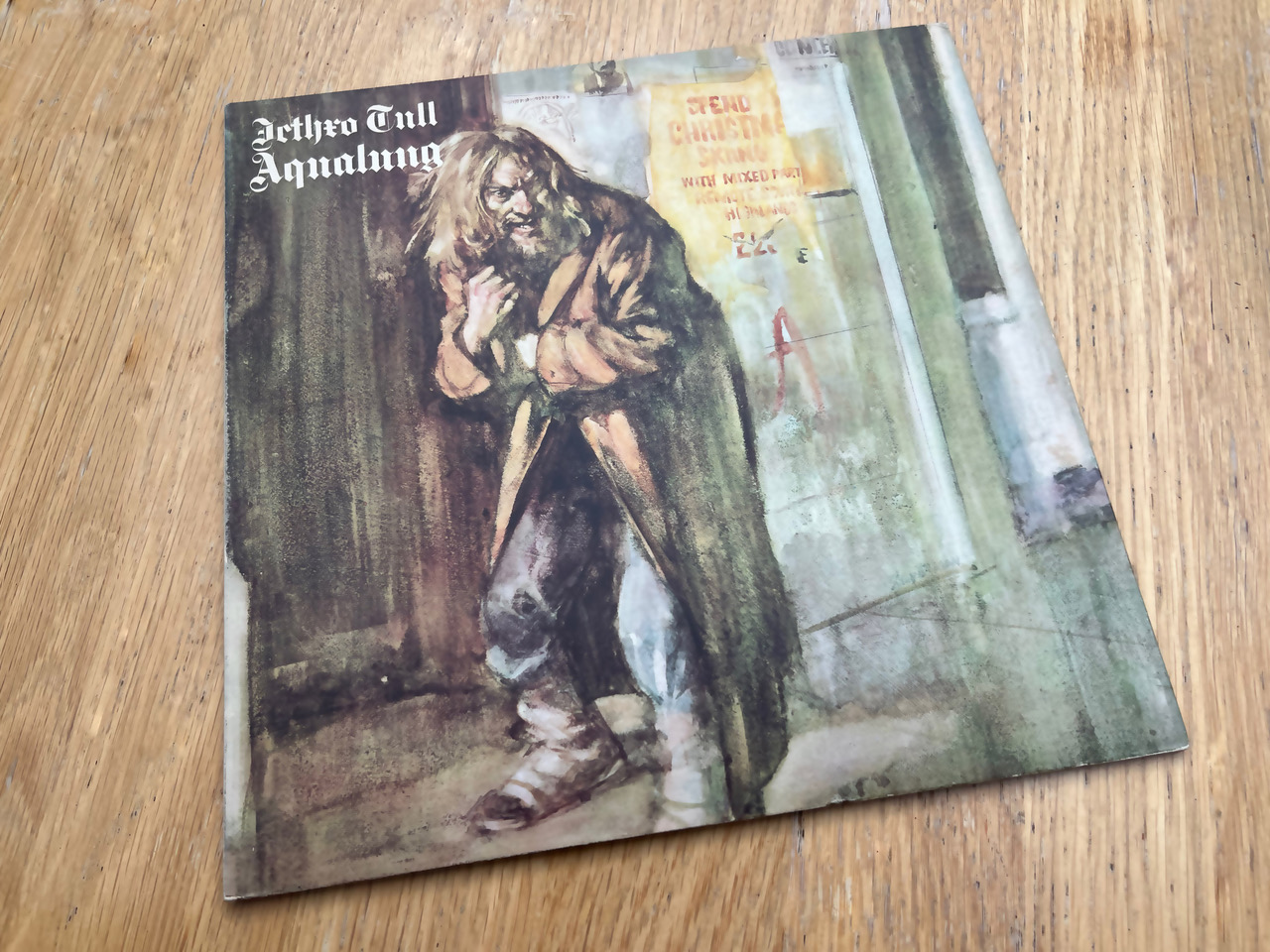 Aqualung is an album I’ve been playing since my early teens. As a child I shared a room with my big brother Richard who, to my massive delight, bought his own stereo record player for our bedroom. It was therefore his early record collection that directed my initial entry into the love of music. One of Richard’s favourite bands, maybe even his outright favourite band at that time, was (you guessed it) Jethro Tull. To this day, I still recall which albums he did and didn’t have. His Tull collection started with Aqualung and ran up until M.U., the 1976 ‘best of’. During this period of big brother-inspired musical weaning(!), Tull released Songs From the Wood – which was a solid gold hit with yours truly – followed by Heavy Horses and then Bursting Out.
Bursting Out was actually the last big bro-inspired album before he left home and I got the bedroom to myself, and my own record player, and started buying my own record collection. Happy days… My journey started with Genesis and Yes, but then a few years later when my brother started getting into CDs, he sold me his entire Tull collection for the bargain price of just £20!
From that point I began to fill in the gaps i.e. everything leading up to Aqualung: This Was, Stand Up and Benefit. There were a couple of mid-period omissions (Minstrel in the Gallery and Warchild) then after that, the only notable additions were the 1988 20 Years of Jethro Tull – The Definitive Collection 5LP boxed set and a rare-as-hen’s-teeth 1984 BBC Transcription Services LP. While this was later than my preferred Tull era, it clearly demonstrated that no matter what era, what line-up, Tull was an amazingly dynamic and tight band. Their live performances were justifiably legendary.
Aqualung
 By far the most memorable of Tull’s albums, Aqualung has always stood out for me and has stood the test of time. Even 55 years later it still resonates (and is still the biggest selling Tull album). But as a teenage boy it wasn’t my favourite. I was deep into Songs From the Wood with its dreamy medieval folk-inspired pastoral Englishness. Aqualung felt too aggressive, which wasn’t a sound I loved back then (and I was discovering Tull right around the time of punk invading the charts, which totally wasn’t my bag back then either – but hey, people change, thankfully…).
By the time I got to university (art school) I’d warmed to the album – and besides, the only two so-called ‘aggressive’ tracks are the first two: ‘Aqualung’ and ‘Cross Eyed Mary’. Everything that follows is a mixture of baroque folkiness and ecclesiastical beauty. And ‘Locomotive Breath’ with its tremendous thundering momentum quickly became my favourite track on the album (like I said, people change…).
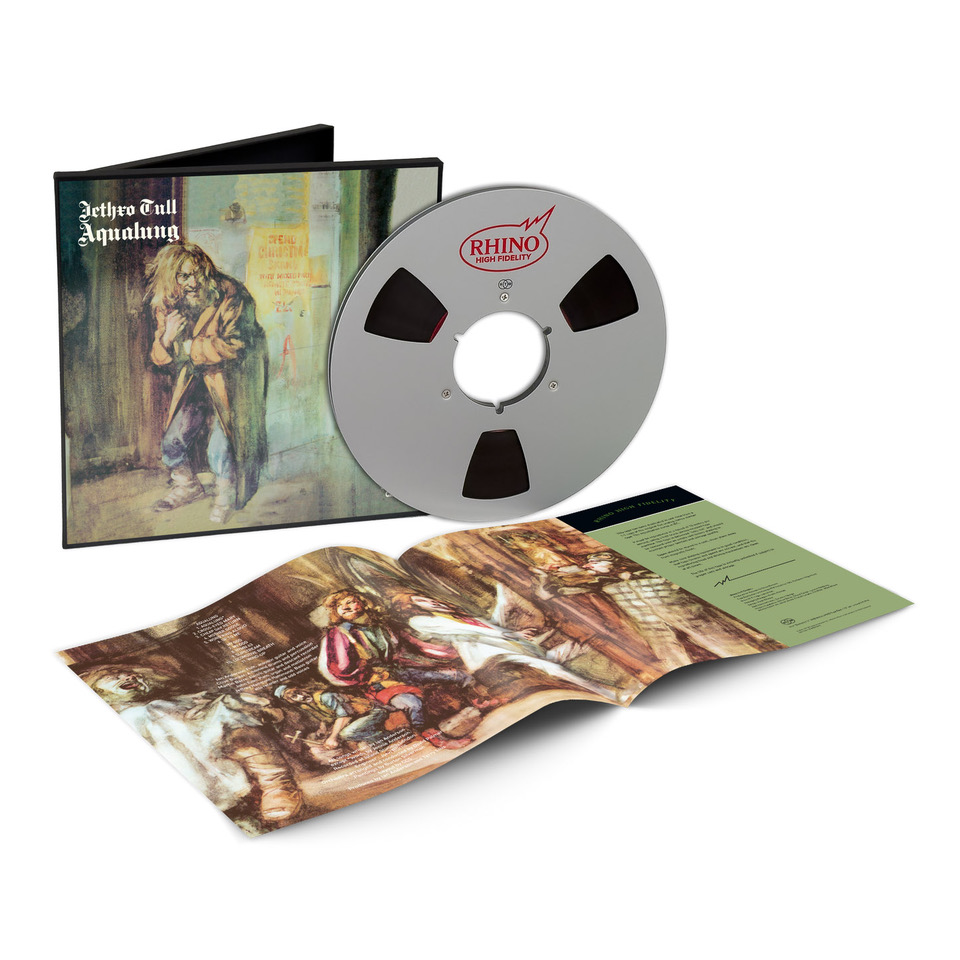
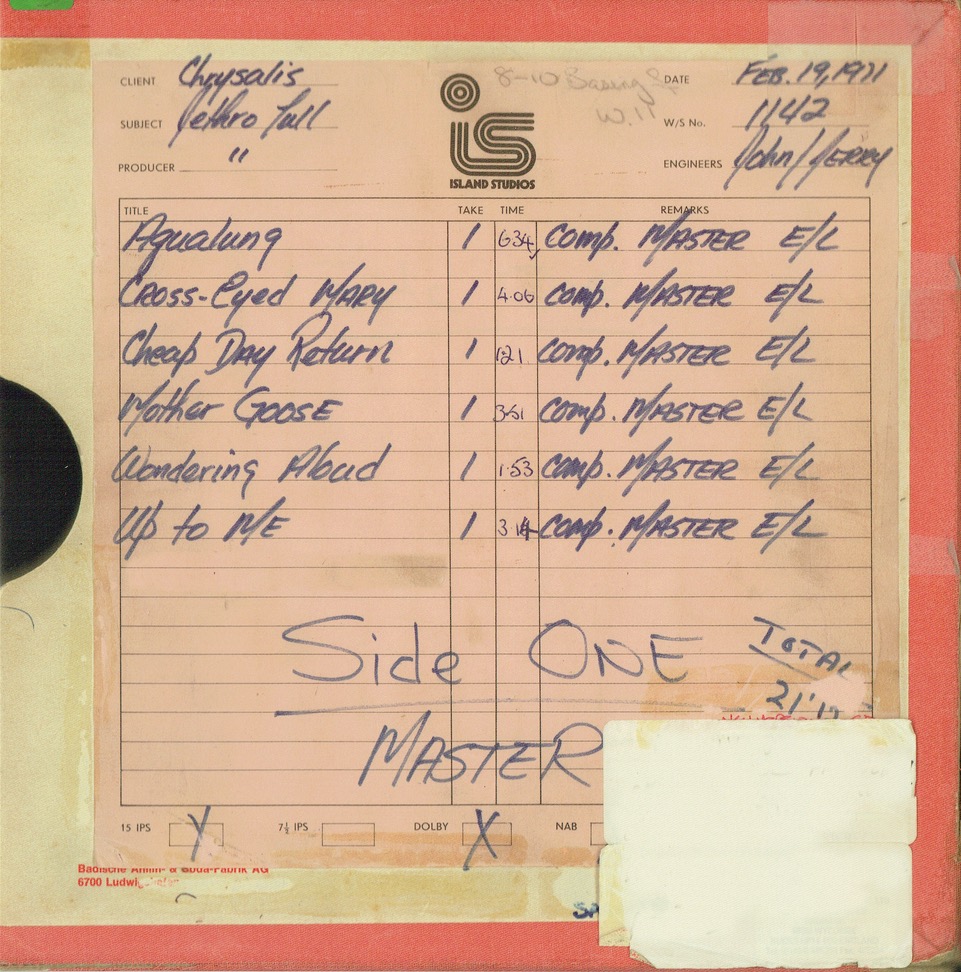
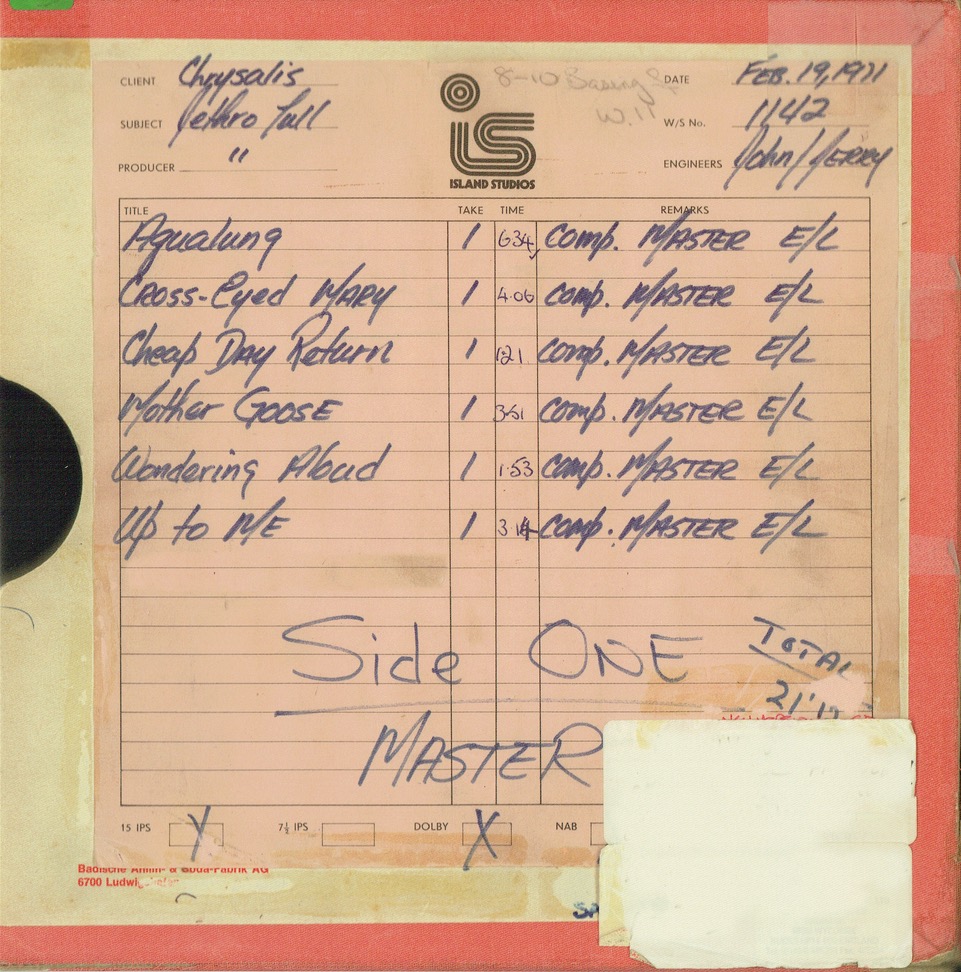
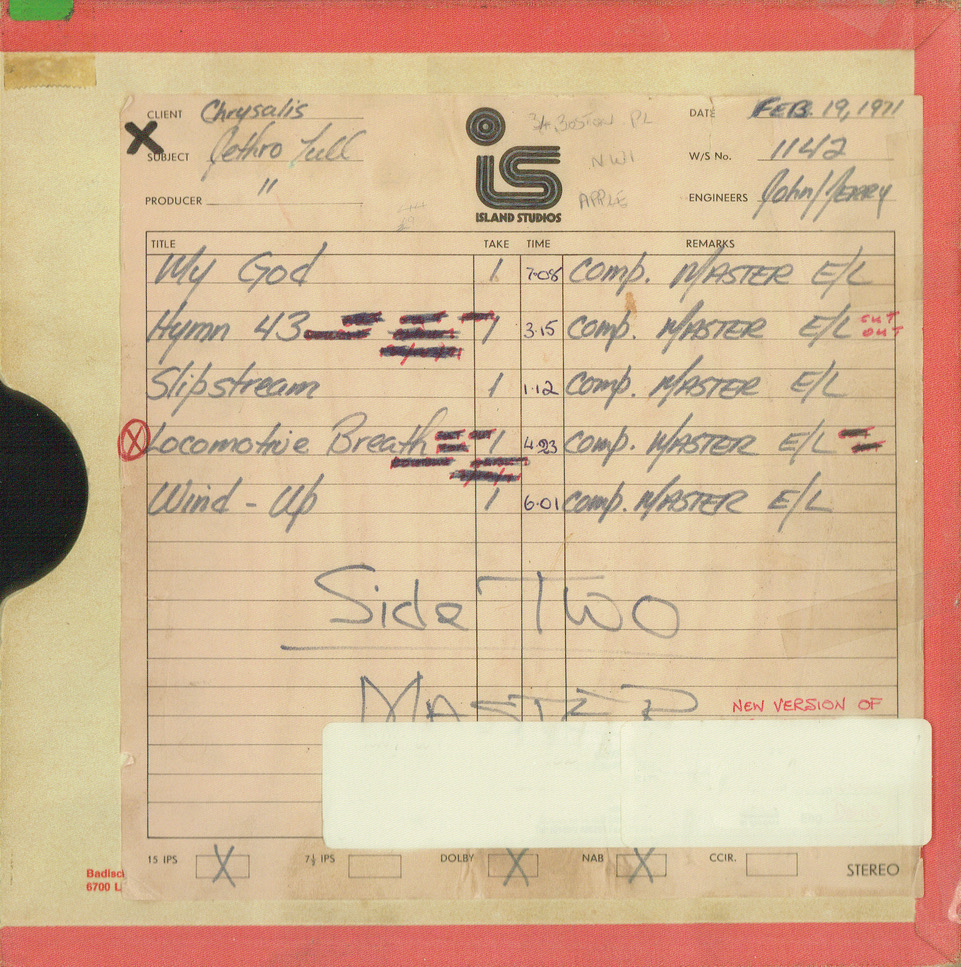
In fact it probably took me until my 40s to really ‘get’ the more deeply probing tracks. These days my favourites are ‘My God’ and ‘Wind Up’. Frankly the message of these tracks shot straight over my youthful head but found immense resonance with my middle-aged spirit. So, to have Aqualung on offer as it is here now: a direct (flat, unequalised, unmanipulated) copy of the original Island Records master tape, is another ‘crown jewels’ moment for me folks. Nothing can be better, bar the actual master itself (or the two production masters that were made at Warner’s mastering studio and sent to Recording the Masters in France for the production of these master copies). For the record (no pun intended) I call the Rhino tapes ‘master copies’ because that’s precisely what they are; the exact tape source varies from title to title, but in this case the tape you hold in your hand is a first generation copy of the production master, itself a first generation copy of the original master. (The actual original master tape box is represented as a life-size photograph in the package.)
The line-up
The original Jethro Tull (as any British school child of a certain age will know) invented the seed drill in 1701 (our early education was riveting stuff, folks).
Jethro Tull the band formed in 1967, very much in the British blues trend of that time. Their first album This Was was released in 1968 and shortly thereafter, original guitarist Mick Abrahams left to form Blodwyn Pig. (Incidentally, Blodwyn Pig’s debut album Ahead Rings Out I’d very strongly recommend). Following Abrahams’ departure, Ian Anderson took over the reins, and guitarist Martin Barre was brought in for the second album Stand Up, which contained more varied inspiration than This Was. Benefit came next in 1970 and was the point at which medieval folk and baroque classical influences started to outweigh those of the blues. Then in 1971 we got Aqualung, which was the real break point for the band and from that point they became a household name.
The songs – a quick tour
Without any doubt, the most famous song is the title track which opens the album. It’s an aggressive, dark and dirty tale about vagrancy. For my money this is pure prog: the song’s construction and arrangement are captivating – from the tortured, hard and heavy opening “sitting on a park bench, eyeing little girls with bad intent”, to the vastly contrasting acoustic of “an old man wandering lonely, taking time the only way he knows”. It’s actually a very sad and poignant song, sensitively written even though at first glance it’s quite repulsive.
The contrast from heavy, dark menacing guitars, bass and drums through to sensitive acoustic poignancy keeps the listener questioning the mood of the song as we move on to track two.
‘Cross Eyed Mary’ is almost Aqualung part two. It starts with a haunting call for Mary from far away deep at the right-hand rear of the soundstage, then proceeds with hypnotically beautiful flute melodies over bass and piano. It’s the take of a disturbed young girl who has taken to prostitution (a classic folk trope). Again, the storytelling is disturbing and superb.
What follows are three shorter, much lighter, songs that really show the direction of baroque classical and British folk inspiration. ‘Cheap Day Return’, ‘Mother Goose’ and ‘Wondering Aloud’ are all charming with elegantly melodic arrangements – a complete contrast to the two openers. Beautiful acoustic guitars and extremely tasteful orchestration arranged by long-term band associate Dee Palmer provide the backdrop to superb vocals and the occasional penetrating electric lick from Barre.
Before I move on, I have to mention bass and drums. Founding drummer Clive Bunker is still in place for ‘Aqualung’ and is sensational. The album is alive with firework-like percussion popping left, right and centre of the soundstage. Right from the album’s start we have deep double drum thwacks which are panned to the extreme right and left channels, the deep thudding ‘boom boom’ echoing across the soundstage between the speakers. The playing is phenomenal: powerful yet deft, it enhances the drive, the spaciousness and the prog interest level tremendously. Interestingly, when Bunker left they found Barrimore Barlow, who continued to carry Bunker’s torch perfectly. In fact Jethro Tull’s list of drummers, and bassists for that matter, has been exemplary. The band’s rhythm section has always driven the music with tremendous momentum, yet with a delightful baroque kind of feel which gives an open and spacious urgency to the compositions.
Bass duties on Aqualung were courtesy of Geoffrey Hammond Hammond (so named because both his mother’s maiden name and his father’s surname were Hammond and that suited the band’s archaic medieval British aesthetic!).
Up To Me comes next, returning to the heavier rock feel of the album’s openers, in which the author contemplates material choices referencing several cultural nuggets of the period – this is one of the things that I really enjoy about Tull – the period references that really resonate with the British Boomer. Anderson’s lyrics are truly worthy of being considered poetry, and remain one of the very alluring aspects of Jethro Tull. The band’s individualism, especially with a lifespan of over fifty years, is a real testament to their worth.
Anyway, now we get to side two. Over many decades, side two has massively grown on me. Subtitled ‘My God’, it questions spirituality and religion in a way that, coming from the then 24 year-old Ian Anderson is profoundly astonishing.
‘My God’ opens the side, and at a touch under ten minutes it’s the longest track on the album. It feels dark and brooding, yet with a distinctly ecclesiastical feel. Powerful and devilishly menacing all at once. It deals with the notion that mankind has created religions to control, to segregate, to distance one clan or clique from another; that we use spirituality to crate barriers, hatred and subjugation (no kidding, man). It’s pretty awesome!
Much as side one moves from dark to dainty and back again ‘Hymn 43’ and ‘Slipstream’ return the listener to a lighter, brighter medieval folk-tinged realm – a fabulous contrast from the darker depths of ‘My God’. And then comes ‘Locomotive Breath’. This thundering rocker deals with mankind’s incessant ‘progress’. It’s an absolute blinder and for many years was my favourite track on Aqualung. (Christ, imagine if they were rewriting it now…).
Until finally, we reach my current favourite track ‘Wind Up’: essentially, a reprise to ‘My God’.
“I asked this God a question
And by way of firm reply
He said, ‘I’m not the kind you have to wind up on Sundays’.”
Enough said. What an album!
Sound quality
Here, I’m comparing the UK original vinyl album, Rhino High Fidelity’s new AAA cut vinyl and Rhino Reel to Reel’s tape.



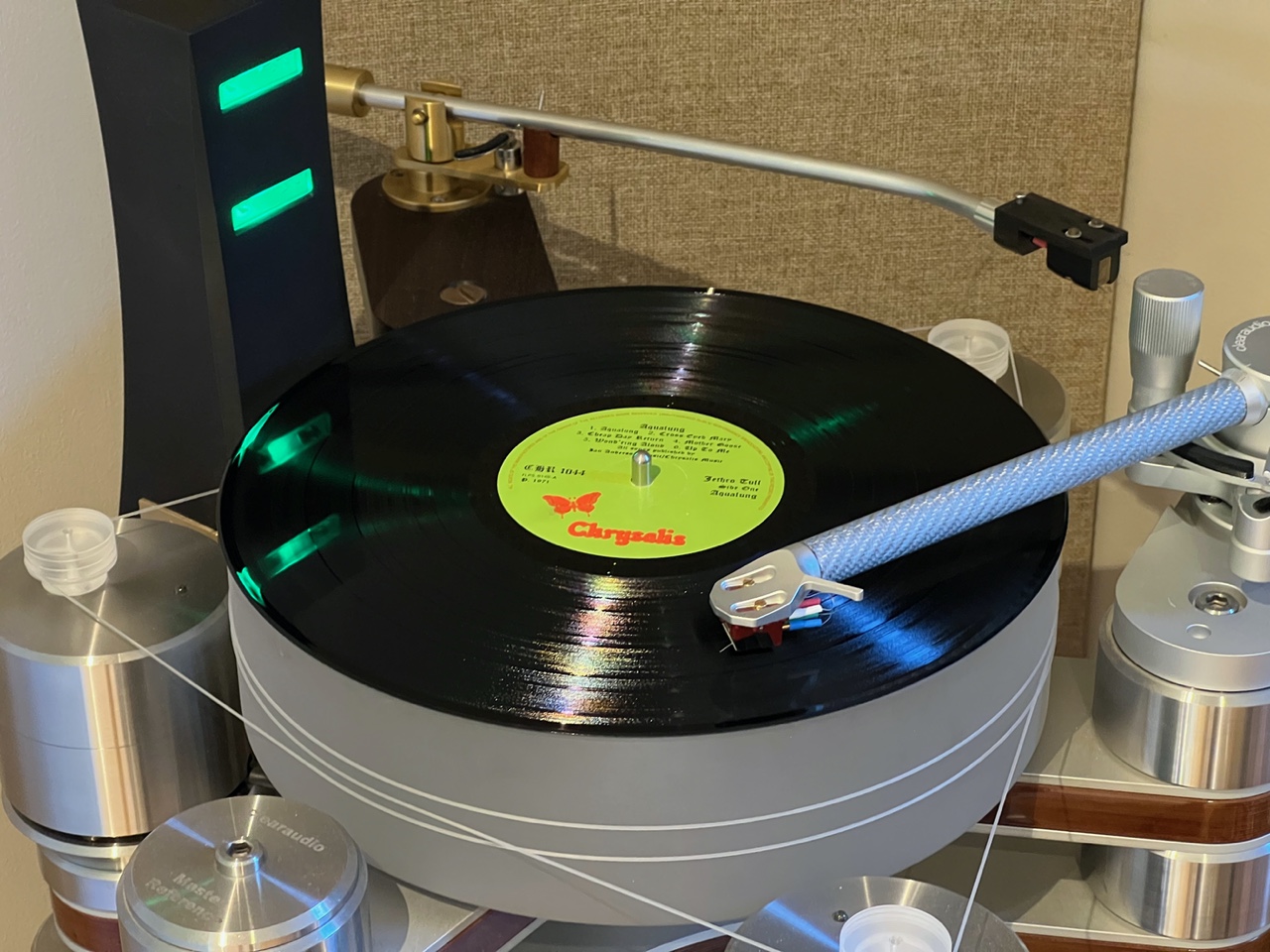
My UK original is that same copy I bought from my brother waaaay back in 1988. It’s a UK 1975 repress with textured gatefold cover. The matrix numbers of my copy are: ILPS 9145 A-1U and ILPS 9145 B-3U which suggest it was from the same original metalwork as the very first pressings. So, after a thorough clean on my Loricraft followed by the Degritter MkII, and a run through the Furutech DeMag demgnetiser, I place my UK original on the turntable and cue up…
After fifty years of enjoying this album, it’s hard to criticise it, but if I push myself to be sit in the sonic critic’s chair, then I’d say that the original’s vocal is just a touch fuzzy. On the louder sections, the guitars also get just a touch indistinct: like defocusing a camera slightly. However, the soundstage is impressively wide and deep. The guitars and piano are bright and airy with a fabulous groove. Bass guitar is defined, but not especially weighty or deep. And while the drumming is sensational, the drum sound is not particularly deep and the cymbals don’t really shimmer. All in all, the driving force of the album is phenomenal, but it’s just a little messy. At more than fifty years old, it’s not the quietest listen either. However, if everything else is right, I can listen through vinyl noise – to a point.
Here’s where the the new Rhino High Fidelity vinyl comes in. I cue up the new Kevin Gray cut vinyl and – wow – things improve dramatically. It’s quite a rarity for a reissue / remaster to be notably better than an original, although do remember my ‘original’ is from 1975.
There’s notably more detail on the opening guitar work, the drums’ pyrotechnic left-right panning is even more apparent, and the lead guitar is deeply coloured, more powerful, more real, more thunderous.
At the bottom end the bass goes deeper and is better defined and that all-important vocal range is cleaner, more detailed and exquisitely expressive. The eery laughing backing voices on Up To Me are sensational. Don’t forget, folks, this precedes Dark Side Of The Moon by a couple of years. I gotta say I’m mightily impressed by the new Rhino High Fidelity vinyl release – this is truly terrific stuff!
Now, over to the tape…


Right from the intro to ‘Aqualung’, everything is cleaner and more spacious, with greater separation between instruments. Guitars have far more colour. The acoustic guitar’s top edges are beautifully bright, allowing you to hear the strings shimmer. The piano is absolutely full of colour, with every single note portrayed explicitly. Drums are in another world; every drum hit is shaped and textured perfectly. The strummed rhythm guitar has just the right amount of ring and shimmer. Bass drum weight extends far lower, so much so that you feel it in your feet! Every bass note starts and stops on the button. Cymbals are wonderful, and for the first time they’re really shimmering. Barre’s guitar breaks are vividly present, while the drum beats explode across the soundstage like fireworks lighting up the sky. Everything is more solid yet more airy, fully weighted while the highs shimmer off into the stratosphere.
Cross-eyed Mary’s ‘Mary’ intro comes from seemingly so far away at the far-right rear of the stage and the picture is immense, life-size and real. Anderson’s flute is bright and sweet, Hammond’s bass tight and tuneful, and Bunker’s drums shuffling yet solid. Barre’s lead guitar is visceral – richly coloured with an almost saxophone-like growl to it. The drums are sooo tight and dynamic. Every note of the bass is tight and tuneful. Anderson’s vocal is forward and sneeringly ‘nasty’. Perfect!
‘Cheap Day Return’ is stunningly vivid, detailed and weighted with super-dynamic guitars. Voice, too, is explosively dynamic. Ian is right there, 5 feet or so in front of me, totally life size.
‘Mother Goose’ – bloody hell, stunning clarity and the weight of that bass drum! Percussion is smooth and rounded, pyrotechnic, popping all over the soundstage. Backing vocals actually have me looking over my shoulder as I thought someone was in the room with me.
Sonically astonishing!
‘Wondering Aloud’ offers up the sweetest vocals, superb presence and body, with stunningly clear and dynamic guitars, wonderful technicolour piano and delicious strings.
‘Up To Me’ – with its eery laughs predating Dark Side of the Moon – comes with superb layering of guitars (acoustic, electric), flute and bass, and percussion is sublime. Anderson’s voice is so full-bodied, textured and absolutely right there.
‘My God’ starts with acoustic guitar picking with an almost railway locomotive pace and momentum, then each phrase holds with expectation as those notes slowly decay. The scene this is setting is beyond captivating, then the vocal cuts in alongside a deep and brooding piano. There’s an aching, searching, exasperation to the vocal. But when we get to “so lean upon him gently, and don’t call on him to save”, the electric guitar, bass and drums absolutely explode into the mix with a hellishly dark and menacing energy. It’s majestic and mind blowing. From here, the arrangement takes us through searing electric guitar solos, an exceptional flute solo and a truly ecclesiastical choral chant. Then we seamlessly slip back into the raw groove with “And the graven image you know who with his plastic crucifix…” Bloody hell, this is phenomenal stuff. Over the years I’ve really come to love this song but here on tape, listening to an exact copy of the master: OMG!
How do you take a song that feels like a church hymn and present it as a full-on rocker? Listen to ‘Hymn 43’ on this tape. Holy cow! A sermon delivered in full-bore, heavy rock ‘n’ roll. That characteristic Barre guitar chunks away, in the mould of ‘Locomotive Breath’. The piano absolutely rocks out, while Hammond’s fingers are flying up and down the fretboard. Drums with tremendous weight thunder across the soundstage. It’s the best I’ve ever heard this song by a country mile. This is what it’s all about!
‘Slipstream’ is another delicate acoustic guitar lead, orchestrated with a madrigal-like beauty… like an acoustic palette-cleanser, if you will, that ends in a psychedelic phase warp and leads into the monumental ‘Locomotive Breath….where a bluesy piano intro with wailing electric guitar thrumming bass takes us into the main theme and into the pulsating, driving, unstoppable momentum of the song. The rhythm guitar chugs away on the far left while the lead wails like a banshee far-rear-centre to front-centre. And the drums roll (again, like thunder) across the stage right there in front of you. Wonderful.
Finally, ‘Wind Up’ is a reprise to the whole album. The lyrics are so cleverly written, I still find it hard to imagine how anyone of just 24 years could have this level of insight into the human condition (I sure didn’t at that age). The sound is sweet, hard and heavy, dense but spacious, rocking yet deeply intricate.
Having heard this tape, you can be sure I’ll be playing it over and over again.
Here’s a bit more rambling on the subject…
Getting a copy
Bad news folks, the tape has now sold out (sorry). So too have US copies of the vinyl.
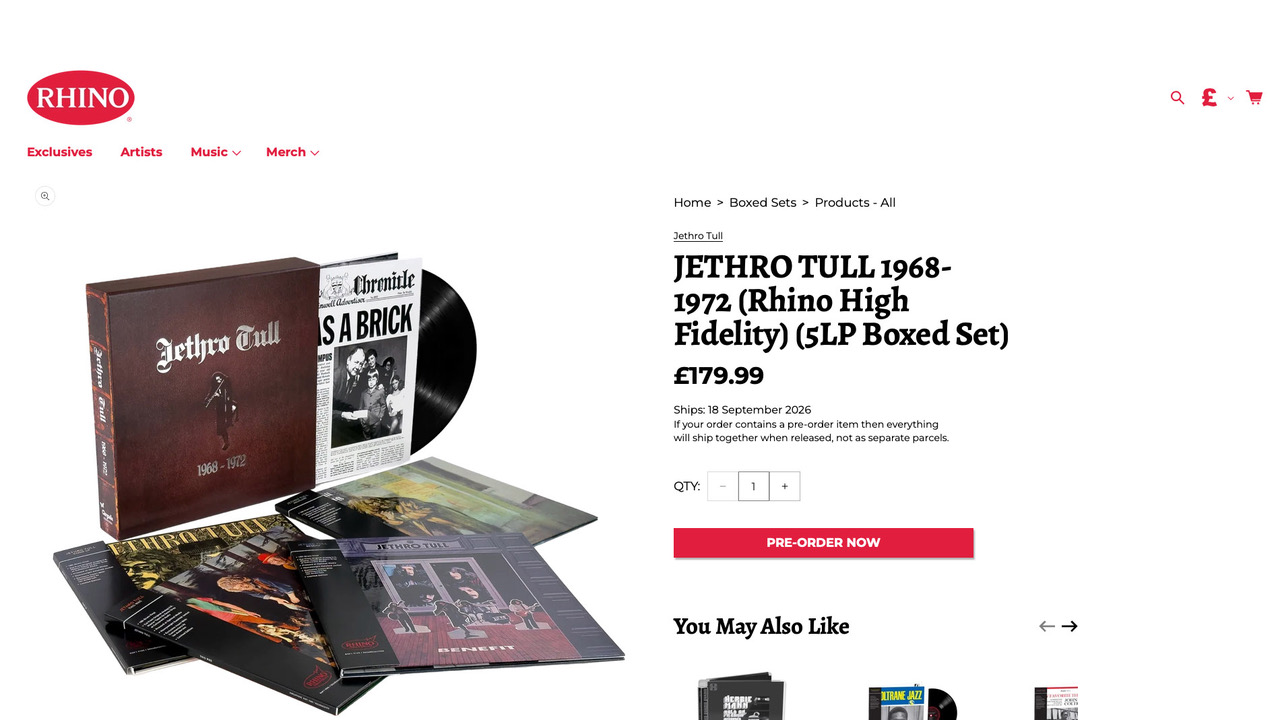
BUT – good news in the UK: the vinyl release (currently only available as part of a five album boxed set: ‘1968-1972’ is showing as available for pre-order from Rhino’s UK webstore, for release TODAY, Friday 18th September. BE QUICK!!! https://eustore.rhino.com/en-gb/products/jethro-tull-1968-1972-rhino-high-fidelity-5lp-boxed-set?variant=46449741987976