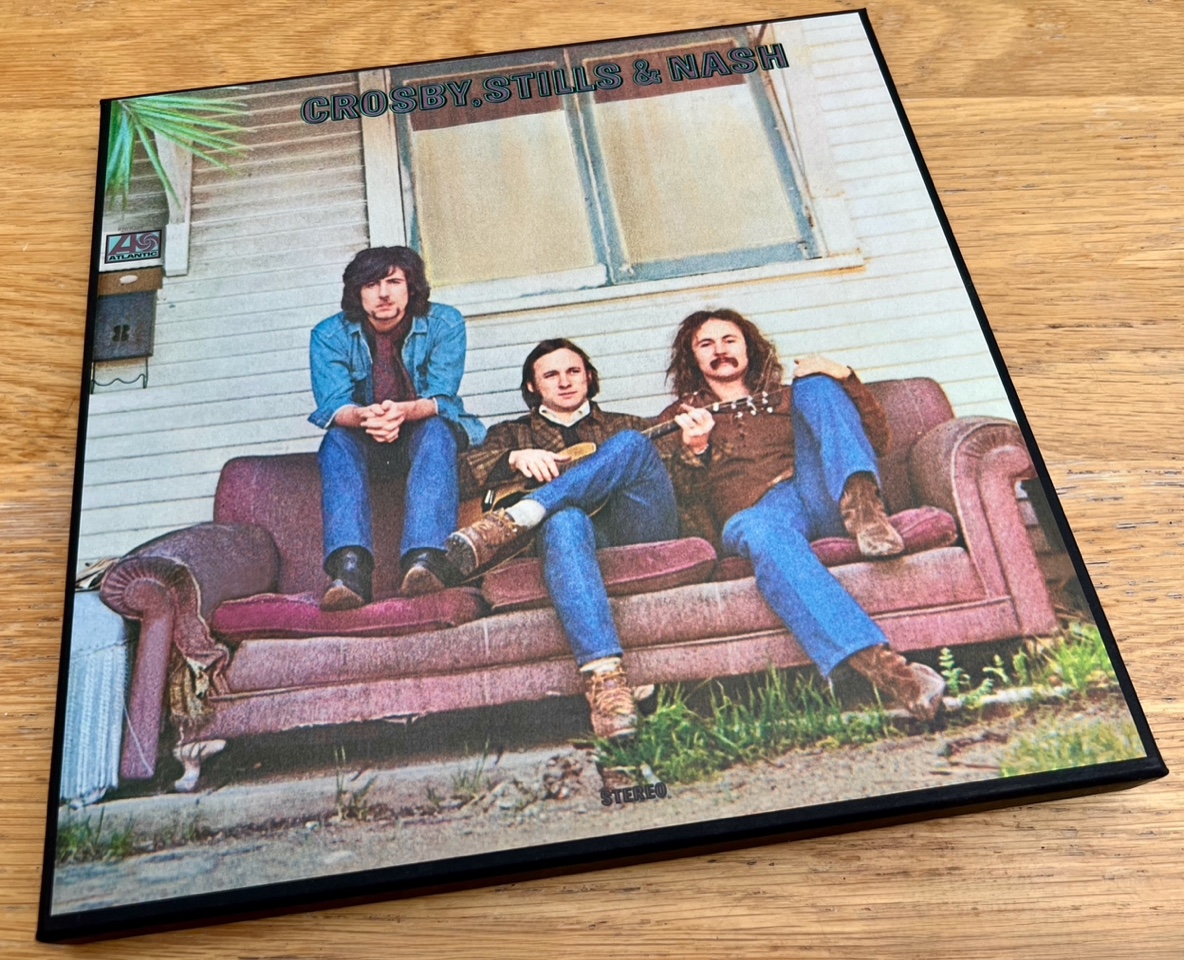
Anyone who’s been following me for a while will know that Crosby Stills and Nash have, for a couple of decades at least, formed the centre of my musical galaxy! While I started out in the world of prog rock, and was at my pop-tastic prime for 80s rock / pop / production, by the 90’s I’d been seduced (ensnared even) by the Woodstock generation. Turning towards the late 60s American rock and pop scene – and pretty much everything that came with it – began to eclipse prog and 80s British pop and rock for me. Everything was now forming a new orbit, one that probably revolved around the debut Buffalo Springfield album and particularly its monumental single ‘For What It’s Worth’.
So, as Buffalo Springfield begat Crosby Stills and Nash, and as Crosby Stills and Nash begat Crosby, Stills, Nash and Young, my entire musical journey took on a new more American, more singer-songwriter, more folk-tinged, more psychedelic theme. For maybe 20-30 years these records have formed the core of my collection. I first signed up to eBay in order to buy a still-sealed original US first pressing of David Crosby’s ‘If I Could Only Remember My Name’. Anyway, you get the gist.
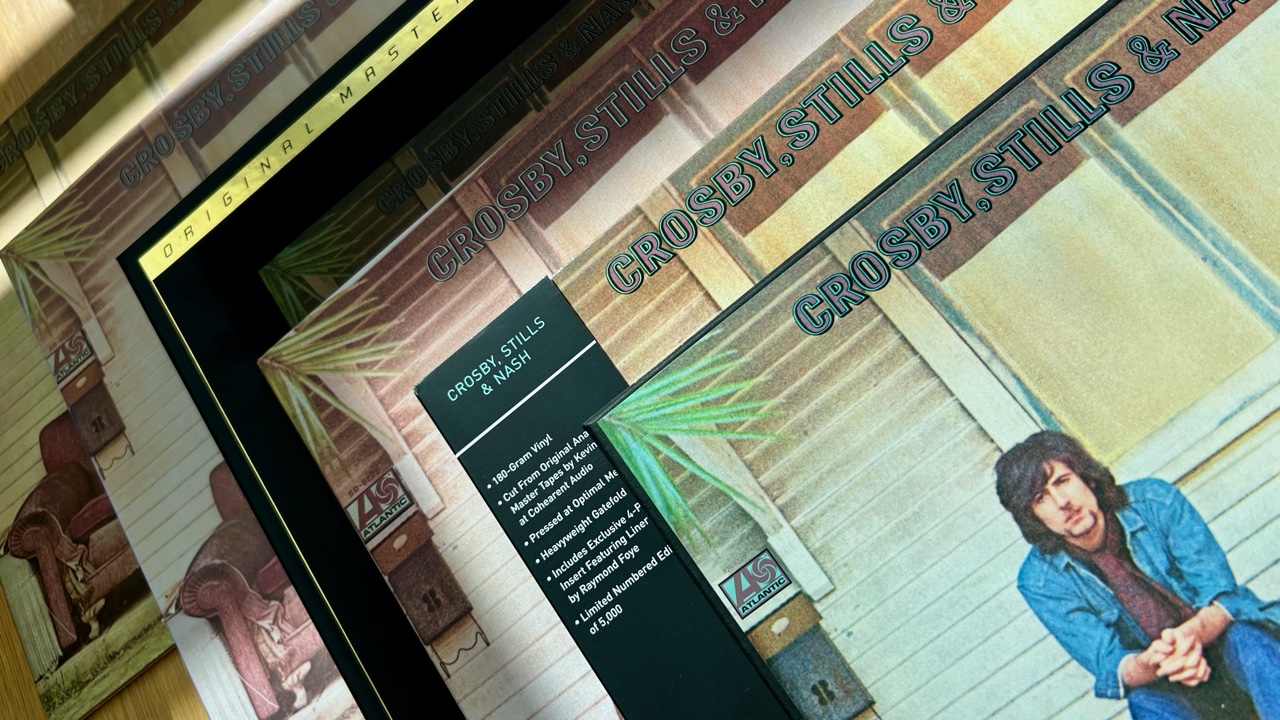
Crosby Stills and Nash is one of my all-time favourite albums, ever, period. I know it inside out and have various ‘ultimate’ versions. That’s how it works in my world: I’m really not that interested in remixes, out-takes, alternate versions etc. What I want is that original composition, that original album in its absolute best form. So, over the years I’ve collected a 1969 UK original on the Red/Plum Atlantic label, the 2001 Classic records cut (Bernie Grundman), the 2022 MOFI One-Step Ultradisc, and the 2024 Analogue Productions Atlantic 75th Anniversary 45rpm cut (Bernie Grundman again).


Along with the new Rhino High Fidelity Reel to Reel, I also just bought Rhino’s AAA Kevin Gray vinyl cut – as it would’ve seemed daft not to. So, for this review I sat down and did a listen / re-listen of all these versions. A kind of six-way shootout if you like.

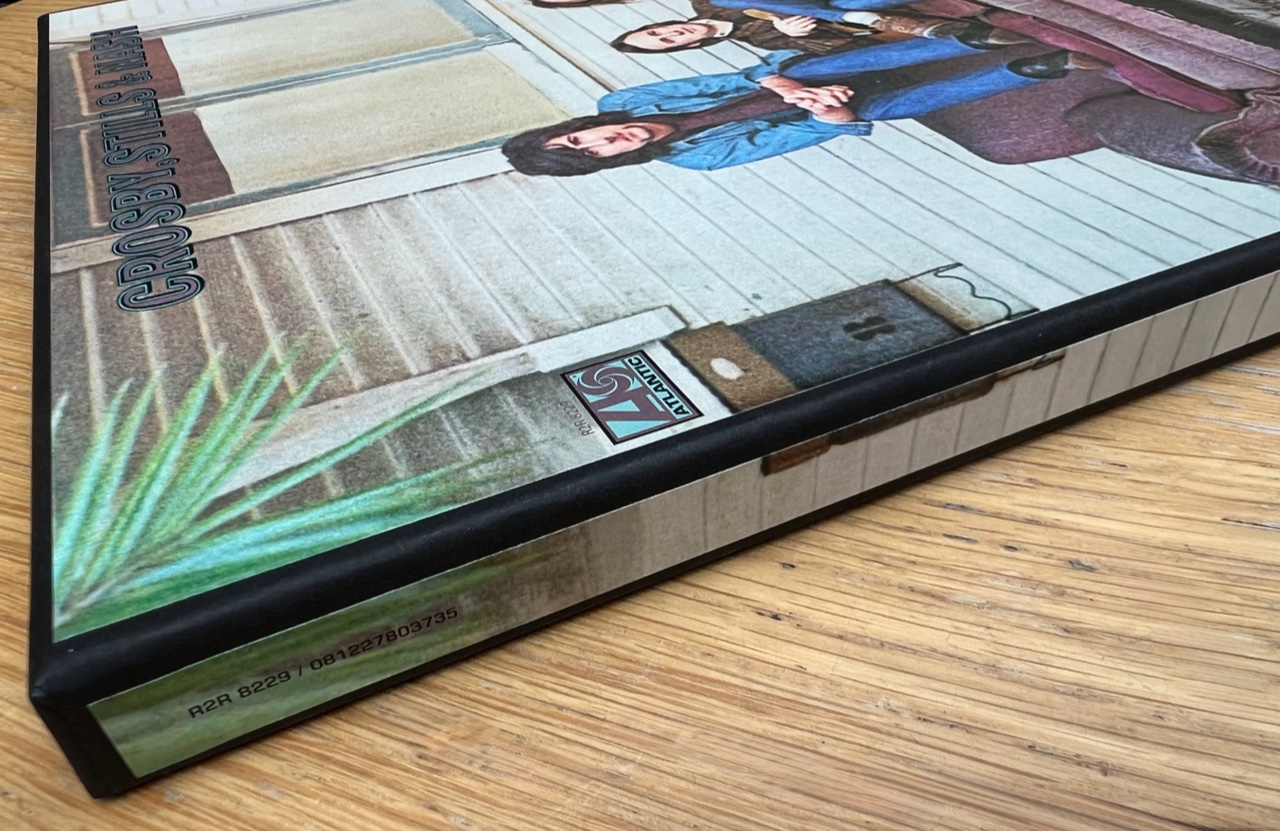
Now, if you’ve read around the online forums about this one, you’ll have seen that there are some doubters out there, specifically in terms of the tape’s bass. So, right off the bat that was rolling around in my mind and before I even started my listening, it was coloured by a nagging question: is there too much bass?
A quick listening preview
Well, that seems like a fairly straightforward question, so I figured I’d get straight to the point on that one. Normally when I’m doing comparative listening tests I start with the vinyl formats and finish with tape (simply because, in my experience, the quality of tape makes is hard to go in reverse). But in this case, because I had the ‘too much bass’ question / itch to scratch, the first thing I played in my A-B-C-D-E-F shootout was the tape. I figured I’d get a sneak previous of just one track, to see what was going down with that whole bass thing.
The album opens with the phenomenal epic ‘Suite: Judy Blue Eyes’, initially with some very hard left-right channel action. Well, that was a joy to hear. Tape typically has incredible channel separation. It also has tremendous dynamic capabilities and the immediacy, detail and presence of those first few phrases were startling and utterly joyous. When you hear something truly better than you’ve ever heard it before, you absolutely know it, without the need to reference anything else. It’s inherently obvious.
And then the bass kicks in… and, as anyone who knows the album will testify, it’s played by Stills and is a fairly ‘big’, soft and rolling kind of bass sound. Well, on the tape it’s certainly is big, soft and rolling. But does it sound too much? Well, for my money – no, not really. The bass is big and ‘fruity’ for sure, but at the same time the voices, guitars and percussion all sound unquestionably more natural and whole, far better separated, detailed, expressive and present than any version I’ve ever heard, by a noticeable margin. So for my money the bass neither takes up too much room nor overstays its welcome. At least on track 1.
Now, back to the shootout – let’s start, in my usual fashion, with the vinyls…
The shoot out vinyl winners
I started with the UK original, vinyl, as this is the copy I’ve owned the longest. In comparison with the tape, the original’s bass has been equalised right back in level but it’s still that same soft, rounded bass. But on the UK original it feels kinda ‘sucked out’ making the voices and guitars seem to have been ‘scooped out’ along with it, leaving them a little spikey and edgy. Not that nice in fact. Of course, this was only in direct comparison with the tape, but being the copy I’d owned and lived with and listened to and loved for the longest time, this was quite a surprising revelation!
However, what I did next was a real eye-opener…I played what was probably the best-sounding version I’d heard until now: the recent Analogue Productions Atlantic 75th Anniversary 45rpm cut. Now, I appreciate that some folks just can’t hack all the jumping up and down flipping sides with 45rpm album releases, but they do typically sound better and so that’s where I went next, to hear how close (or not) the 45rpm cut got to the tape. Well, I’d say it was the closest of all my vinyls, or maybe about equal alongside the Rhino Kevin Gray cut. These two come closest to the tape, by quite some margin.
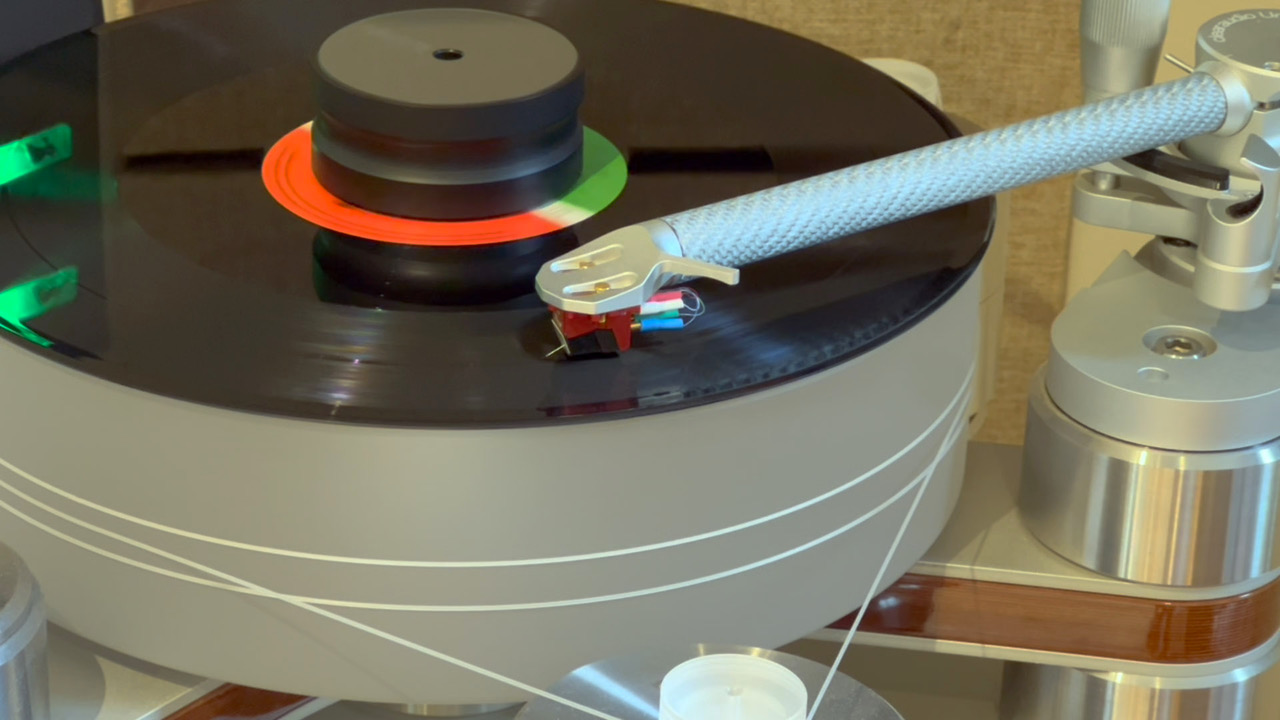
But here’s where it all gets pretty interesting – that bass question again. How does the bass of the Analogue Productions 45rpm cut compare to the Rhino tape? Well, it’s surprisingly similar. Clearly the ‘advantages’ of cutting at 45rpm allowed the mastering engineer to not reduce all the bass frequencies that were almost eliminated from the original. In fact, all of the ‘audiophile’ reissues of the album have notably more bass weight, and a softish rounded weight at that, compared to the rather ‘scooped out’ sounding original.
So I’m gonna stick my neck out here and say I think we can pretty much forget the bass question! I’m guessing that the negative comments out there probably came from folks who are mostly familiar with the original album, and that’s fair enough. The master tape, of which this Rhino Reel to Reel is an exact 1:1 copy, has the bass it has. Bill Halverson (the engineer) and Crosby, Stills and Nash, the producers, mixed it like this and signed off the master. So it’s hardly an error!
I’d also add, however, that this ‘full bass’ isn’t on all the tracks, it pretty much only occurs like this on ‘Suite: Judy Blue Eyes’ and ‘Long Time Gone’. The bass on the remaining tracks is nowhere near as full.
A few notes on the source of the tape
I’ve noticed that some of the audio forums and video discussions have been ablaze with ‘horror stories’ that the Rhino tapes are eq’d copies, or maybe ‘not’ mastered for production, based on masters ‘not intended to be heard’. Which gave me a laugh – I mean, when Eddie Offord was recording and mixing Close to the Edge, he wasn’t intending for Steven Wilson to come along with a digitally sampled multitrack and redo all his work! Let’s face it, no-one in 1972 would have had a clue what ‘digital’ was. Nor, folks, did George Martin intend for his son coming along and, with the aid of AI, unstitching his work and redoing it for the next generation. In other words, there’s a whole lot we listen to that bears little or no relation to the original intention!
Anyway, let’s just check here precisely what this tape is: because folks, Rhino give you a photographic copy of the actual tape boxes. There’s no better provenance than that. In this case, this is what it is: the MASTER. Interestingly it doesn’t even appear to have Dolby A which in my reckoning makes it even better, even purer. And let’s look at what it isn’t: it is NOT an ‘eq’d limited master’ (which would still be ‘a’ master incidentally). It’s not a ‘1:1 copy’ (which would also still be a master), it’s not a ‘safety master’, it’s not a ‘cassette duplicating submaster’ (which is still technically a ‘master’), nor is it an ‘8 track duplicating submaster’. Get the picture? The tape source used for this Rhino High Fidelity Reel to Reel is (the / an)* original MASTER. Were there more than one of these made? I don’t know. Sometimes there is, sometimes there isn’t, but you know what, unless one of them gets damaged, who cares.


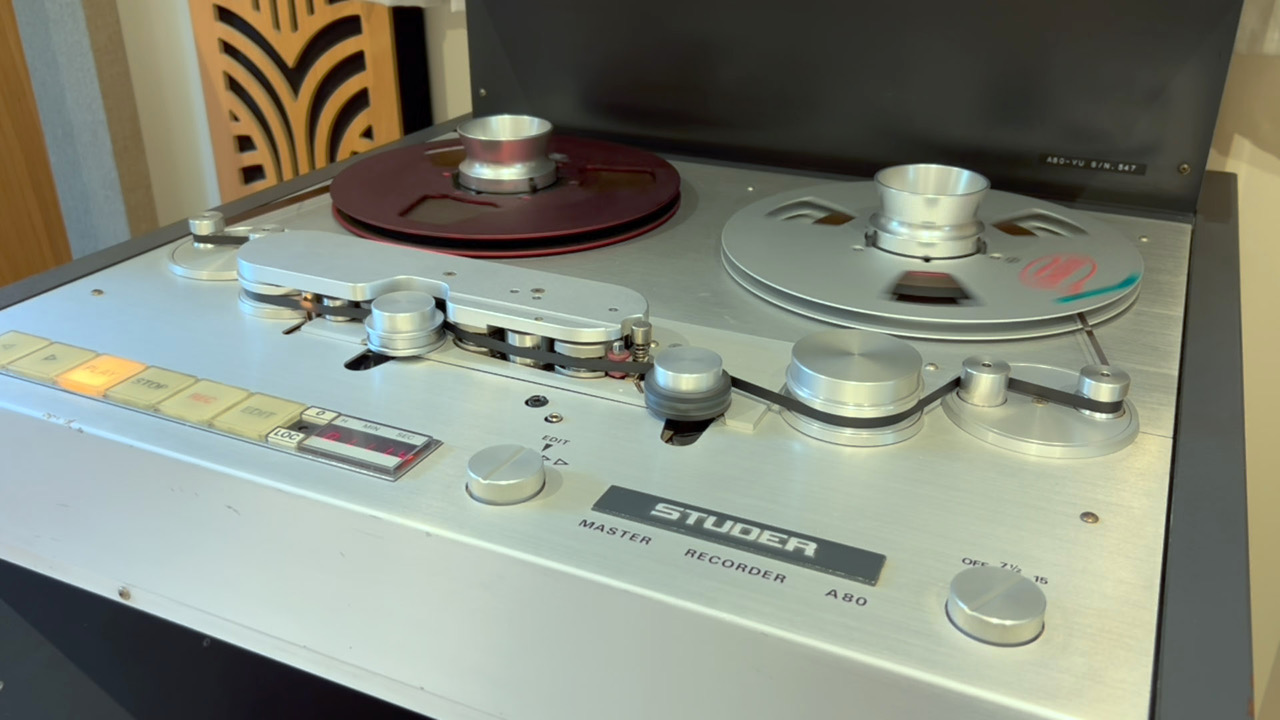
So, let’s face it the source is the MASTER… So how does it get from the master to you? Here’s how: two professional studio quality ‘flat’ (unequalised) copies were made from the original master tape (pictured) by Rhino. Rhino chooses to call these ‘flat production masters’ which precisely describes what they are. For those that want to know, these production masters are made concurrently by hooking up two Ampex ATR102 master recorders to one master playback machine, so they’re effectively ‘twins’, of the same generation. They’re made at 320nWb/m and in the modern CCIR equalisation. These two production masters are then sent to Recording the Masters in France where they’re duplicated in a system with one playback machine connected to 5 recorders to create, in real time, the studio quality tapes that you buy.
In short, I have here in my hands a direct first generation copy of the production master, or putting it another way a second generation copy of the original master. (We have to be a bit careful of nomenclature as many people will call the master the first generation tape, making the production master the second generation tape making what we have here the third generation tape – kind of like the way we call the bottom level of a building the ground floor in the UK and the first floor in the USA!). So, third generation tape or first generation copy of the production master. It amounts to the same thing. I really don’t think it matters as long as we understand what it is: and that is a very, very special thing indeed!
What it’s important to remember is, there’s never ever been a closer to the original release than this, period. End of rant. Now, let’s have a proper listen to the darned thing…
Listening to the tape
From those very first guitar notes, far to the left of the soundstage the sound is massive, and dramatic. The timbre is far more natural than any of the five vinyl versions I’ve already listened to. There’s an immediacy and dynamism that’s almost startling, but without any hint of harshness.
The bass, when it comes in dead centre, is full, rich and rounded but it honestly doesn’t encroach on the vocals and guitars (for my money anyhow – you’ll have to make up your own mind).
The three vocals, all placed centrally, are clear and natural sounding, not bright, just sweet, but unlike many of the vinyl pressings they have good projection, infinitely fine detail and a full-bodied expression and feeling. They’re much better than any of the five vinyl versions.
The electric lead guitar licks (far right) are subtly portrayed. In fact everything in the mix is easier to hear. The degree of layering and information is vast compared to the vinyl versions (the Analogue Productions Atlantic 75th Anniversary 45rpm version was next best here). When the vocal harmonies are close, as in, say, Crosby and Nash singing close harmonies, they operate almost as one, whereas Stills’ southern blues-rock drawl really wails.
‘Marrakesh Express’ comes in with its lighter, exceptionally clear vocals, again they’re sweet and beautifully layered. You effortlessly hear deep into the mix and truly enjoy this bouncy pop song. The guitars are sweet and clear again, but not harsh nor clipped or edgy. It feels neither forced nor squashed. It just breathes with natural energy and life.
Now we get onto one of my all-time favourites ‘Guinevere’ (or is ‘Suite Judy Blue Eyes’ my top track – who knows, I guess it changes). This Crosby-penned classic sounds exquisite and captivating. The guitars and Crosby’s vocal are captured deliciously – so clear, so clean. It’s literally tear-inducing stuff. David Crosby has a subtle lisp which you can hear implicitly as he sings “she shall be free” and there’s a bit of vibrato, a slight wobble, and it all adds up to an intensely real, emotive presentation that makes you feel like the man is in the room singing for you. There’s a depth and resonance to Crosby’s voice here that’s really new to me. Even though they occupy a similar space in the soundstage, the timbral separation between Crosby and Nash is wonderful. The physical presence of Crosby is vivid, more so than I’ve ever experienced before. I swear I can almost see his mouth, his tongue, his teeth, his lips and his moustache (which I appreciate sounds a bit weird!). And the guitars are beautifully delicate and detailed, with almost imperceptibly subtle bass underpinning this absolute masterpiece.
The soundstage is utterly massive as ‘You Don’t Have Dry’ bursts from the speakers. The guitars sparkle and shine but they do so delicately, there’s no hint of artificial brightness. The bass guitar, meanwhile, is tidy and tight. The vocal layering is in another league to any other version released before. This is Crosby Stills and Nash as it was originally created. You really feel that’s what you’re listening to, not something subsequently messed around with.
The last track of side 1 of the original album ‘Pre Road Downs’ comes next, and Nash takes the lead vocal with Stills’ organ far right, overlaying a backwards guitar slightly left of centre stage. It’s one of the more rocky tracks with the drum kit placed far right. Everything in the soundstage is brightly lit, vivid and rocking. There’s no way by this point in listening to the tape that you won’t be hooked. It raises so many veils, revealing so much more detail and subtle layering into the mix than you’ll have ever heard before.
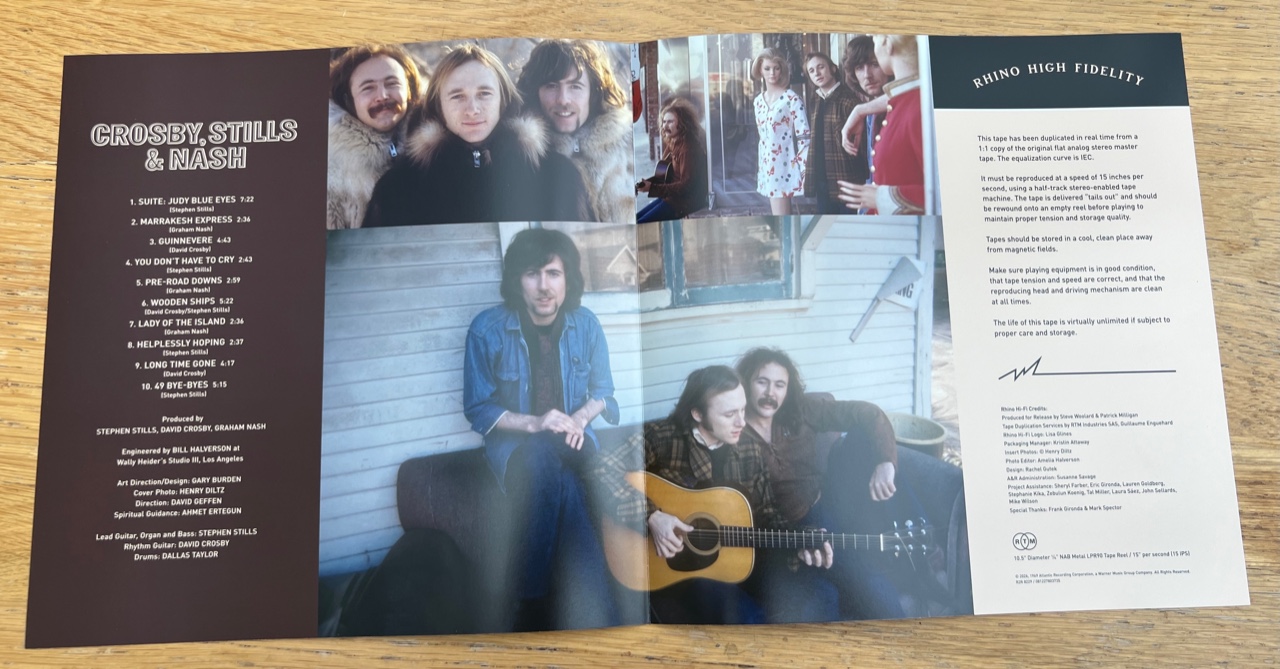
Whereas on the original, Classic and Rhino vinyl albums you’ll have just flipped sides (and on the two 45rpm contenders you’re now onto side 3), here on the tape it just keeps rolling.
‘Wooden Ships’, another absolute favourite, opens with the heavily damped echoey guitar that plucks deep in the soundstage. The sense of presence is astoundingly solid despite the guitar’s physical distance at the back of the stage. It’s soon joined by the jangly electric rhythm guitar, on the far right the majestic organ, and the phenomenal sounding drum kit. Then the creamy bluesy electric lead guitar comes in, centre stage. It has such a beautiful tone and carries the song forward until Stills opens the vocal from the far right of the stge. His voice is visceral, you can almost reach forward and touch him! And then Crosby answers from hard left, equally present, equally right there in front of you. For the choruses, the trio sing centrally placed, then the lead guitar takes off, again it’s smooth and creamy, yet every note is clearly delineated. Organ joins in from far-rear right. Meanwhile I’m hearing more gymnastics from the guitars I’ve ever heard before…. stirring stiff!
Next up is ‘Lady of the Island’, in which Nash’s North West English accent (mid left of the stage) proves to be a stark contrast to Crosby and Stills (mid right), and the space around the voices is amazing. The sound is stunning, I couldn’t imagine it being better. It has an almost ecclesiastical quality to it.
Have I already said ‘my favourite track’? Well, here’s my third or fourth (I’ve lost count) favourite! I absolutely love ‘Helplessly Hoping’. “They are one person, they are two alone, they are three together, they are four each other…” The guitars and the vocals are just perfect. The dynamism of the vocals is spectacular and the way the lead vocal drifts from Crosby and Nash to Stills and back again is sublime. The presentation is wide, open and dynamically alive. Hours, even days after listening, that chorus still haunts me – in the nicest possible way.
‘Long Time Gone’ is another heavier rocker. The bass here is fat, big and full and this is the only track besides ‘Suite: Judy Blue Eyes’ where I could imagine anyone possibly having an issue with the bass. But, for me, it doesn’t swamp over everything. It just sounds big. In fact, this is one track where I felt the urge to turn up the volume even more! I actually cranked it up another three decibels just to release that extra energy from this high powered rocker.
Closing the album is the Stills’ penned ‘49 Bye Bye’s’. As the track opens you can hear Crosby from way back at the rear of the studio, before the songs starts for real with the organ, guitars and bass taking up the groove. The drum kit is more central – just right of centre and is superbly captured with its slip-slidey groove. The vocals are vivid and visceral, the three singing together. What a way to close…
But if you’ve an appetite for more, here’s my video ramble:
You can get your copies at:
- Tape: https://store.rhino.com/products/crosby-stills-nash-rhino-high-fidelity-r2r?variant=51177560211702
- Vinyl: https://store.rhino.com/products/crosby-stills-nash-rhino-high-fidelity?variant=51177559654646
PS. If you’re in the UK / Europe and have been having ordering issues, see my latest update on this.

